Learn how to align your sales and marketing teams so your startup closes more deals and grows faster.
Aligning your sales and marketing teams means building shared goals, shared data, and shared accountability so both sides work toward the same revenue outcomes. When these two teams stop working in silos, startups close deals faster and waste fewer resources on leads that go nowhere.
Most startup founders treat sales and marketing as separate functions. One team generates leads, the other closes them. But when marketing hands off leads that sales considers unqualified, or sales ignores content that marketing spent weeks creating, you get finger-pointing instead of pipeline growth.
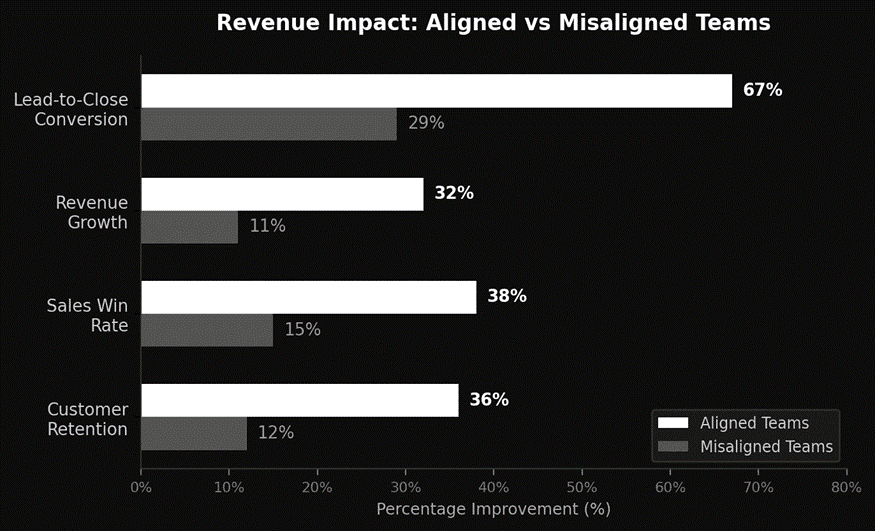
The disconnect is expensive. Companies with strong alignment see 36% higher customer retention and 38% higher win rates. For startups on tight budgets, that efficiency is survival.
Why Do Sales and Marketing Teams Misalign?
The root causes are consistent across startups of every size:
• Different definitions of a qualified lead. Marketing counts MQLs. Sales wants SQLs. Nobody agrees on what “ready to buy” actually means.
• Separate tools and dashboards. When teams track progress in different systems, they build different versions of reality.
• No shared revenue goals. Marketing celebrates traffic. Sales celebrates closed deals. Neither owns the journey between.
• Poor communication cadence. Standups get skipped. Feedback loops break. Resentment builds quietly.
How Can I Align Sales and Marketing in My Startup?
Start with these steps that work even for small teams:
• Create a shared lead definition. Agree on specific criteria like budget, authority, need, and timeline. Write it down and revisit quarterly.
• Use one CRM for both teams. HubSpot or Pipedrive lets marketing see what happens after handoff and lets sales see which content drives interest.
• Set shared revenue targets. When both teams own the same number, blame games disappear. Marketing tracks pipeline contribution. Sales reports on lead quality.
• Hold weekly alignment meetings. Fifteen minutes is enough. Review what works, what does not, and what to change.
• Build a content feedback loop. Sales knows the objections. Marketing can create content that handles them before prospects talk to a rep.
A strong organic growth strategy ties these efforts together, making sure content and outreach serve the same goals.
What Metrics Should Aligned Teams Track Together?
Skip vanity numbers. Focus on metrics both teams can influence:
• Lead-to-close conversion rate shows whether marketing sends the right people and sales follow through.
• Sales cycle length reveals friction points. If deals drag, alignment might be the core issue.
• Content-influenced revenue tracks which blog posts or landing pages contributed to closed deals.
• Customer acquisition cost (CAC) drops when teams stop duplicating efforts and collaborate on shared priorities.
Startups that invest in SEO blog writing often find that optimized content gives sales teams real ammunition, from posts that answer prospect questions to pages that pre-qualify buyers.
How Long Does Sales-Marketing Alignment Take?
Most startups see measurable improvements within 60 to 90 days. The first month builds shared definitions and communication habits. The second month reveals data patterns. By month three, expect shorter sales cycles and better lead quality.
The key is consistency. Alignment is not a one-time workshop. It is a system you maintain every week.
The Bottom Line
Sales and marketing alignment is not about forcing two teams into one room. It is about building systems where shared data, shared goals, and honest communication replace silos and guesswork. Startups that get this right grow faster, spend less on acquisition, and keep more customers.
Ready to build a growth system that connects every part of your marketing engine? Visit viral-impact and let Viral Impact help you turn alignment into revenue.