Learn the exact blog post structure that helps you rank on Google and get cited by AI tools.
A well-structured blog post opens with a keyword-rich H1, a direct two-sentence answer, and question-based subheadings that mirror real search queries. Google and AI platforms both reward content that answers fast, flows logically, and makes it easy to scan.
Most startups treat blog posts like essays big intro, slow build, conclusion at the end. That approach doesn't rank. Google rewards posts that deliver the answer early and structure the rest around how readers actually move through content. Here's the framework that makes it work.
What Should Go at the Very Top of a Blog Post?
Your H1 is the first thing search engines read. It should contain your target keyword and promise a clear outcome. Right under it, place a direct, bolded answer of two to three sentences. This is what Google pulls into Featured Snippets and AI Overviews.
Below that, write one short paragraph that frames the article. Under 60 words. No warming up, no throat-clearing.
How Should You Write Subheadings for SEO?
Subheadings do two things: they help readers skim, and they show Google what the post covers. Write each H2 as a question, specifically, the kind someone would type into a search bar.
That's how you trigger People Also Ask. It's also how AI tools like ChatGPT and Perplexity decide which content to cite.
• One main idea per H2, no cramming
• Use H3s for sub-points under each H2
• Weave in secondary keywords naturally, not forcefully
• Keep each section under 200 words
Aim for five to eight H2s per post. That signals topical depth without padding.
What Should Each Body Section Contain?
Each section should follow the same rhythm: a short setup sentence, then the actual content in bullets or tight paragraphs, then a quiet hand-off to the next idea.
Write for someone smart who doesn't have time to waste. Short sentences work better than long ones here. If a sentence can be cut without losing meaning, cut it.
For content built from the ground up to rank, including keyword targeting, structure, and formatting, Viral Impact's SEO Blog Writing service handles the full production pipeline.
If you also want posts to appear in AI-generated answers, not just search results, Viral Impact's AEO Blog Writing service structures each article for Featured Snippets, AI Overviews, and tools like Perplexity.
Where Should Internal Links Be Placed?
Internal links belong inside body paragraphs, not dumped at the bottom as an afterthought. Link from a relevant phrase to a related page. One or two links per 300 words is a workable pace.
Done right, internal links help Google map your site and help readers find what they need before they leave.
How Should a Blog Post End?
Close with a summary of the main takeaway and one clear next step. Don't trail off. Readers who make it to the end deserve a landing point, not a fade.
One strong CTA. End with direction.
What Is the Right Blog Post Length for SEO?
There's no fixed answer. For most competitive keywords, 800 to 1,500 words is a solid range. Shorter posts can rank if they answer the query better than anyone else. Longer posts win when they cover a topic more completely.
Structural Element | SEO Purpose | Recommended Spec |
H1 Title | Primary keyword signal | 1 per post, 50–60 characters |
Opening Direct Answer | Featured Snippet capture | Within the first 100 words |
H2 Subheadings | Topical depth + PAA targeting | 5–8 per post |
Internal Links | Site structure + authority flow | 2–4 per post |
Word Count | Depth signal to Google | 800–1,500 words |
Closing CTA | Conversion + next step | 1 per post, at close |
For a detailed walkthrough of the full writing and ranking process, this guide on how to write blog posts that rank on Google covers everything from keyword selection to publishing.
The Bottom Line
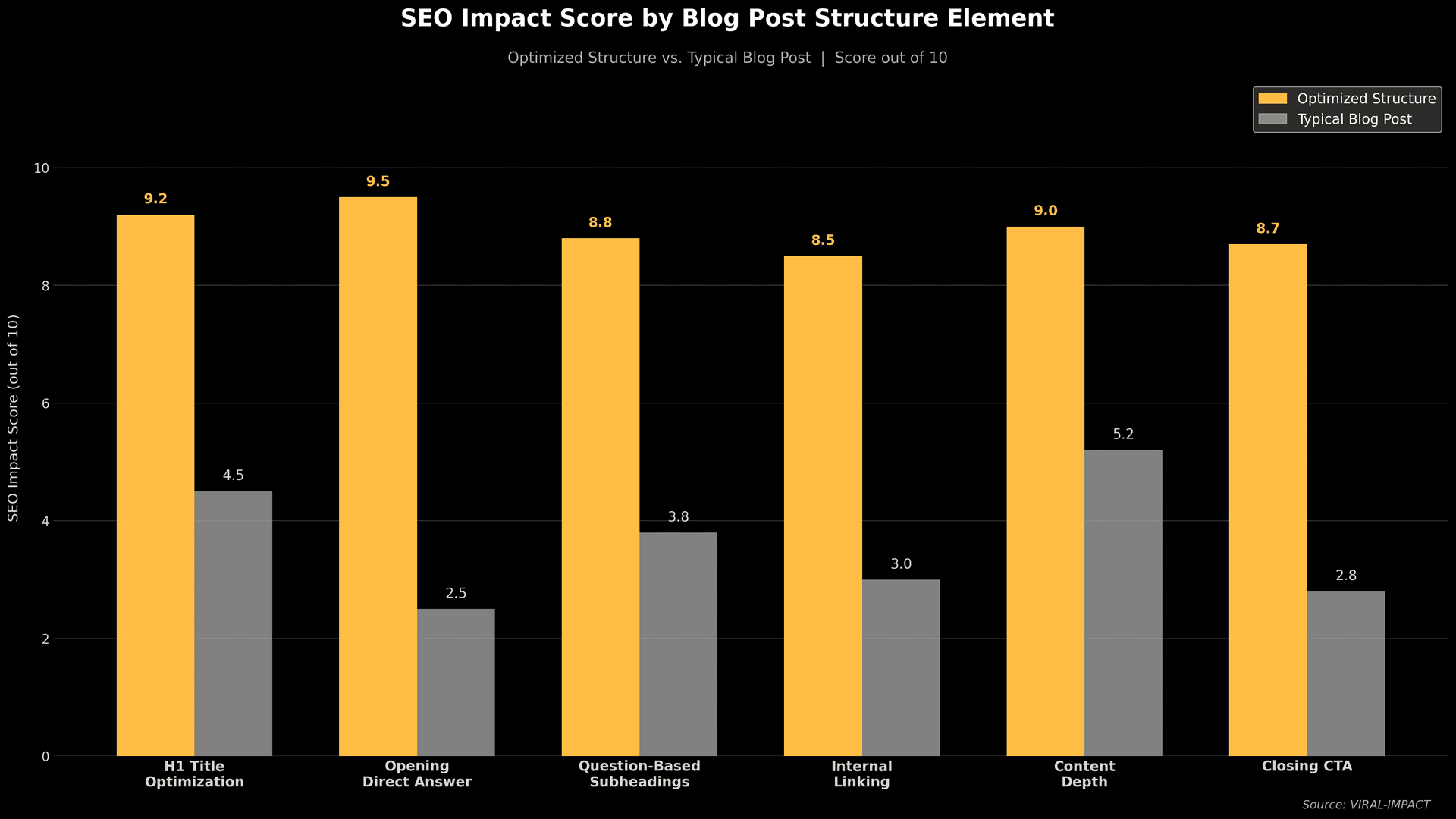
Blog structure isn't a style choice; it's a ranking signal. Every element from your H1 to your closing CTA tells Google and the reader something. Get the H1 right. Answer fast. Use question-based H2s. Link internally. End with purpose.
If you want posts that rank, convert, and hold up over time, visit Viral-Impact. We build content systems for startups that need real results without burning budget on ads.