Discover exactly how many follow-up emails you should send, the ideal timing between each one, and proven sequences that convert.
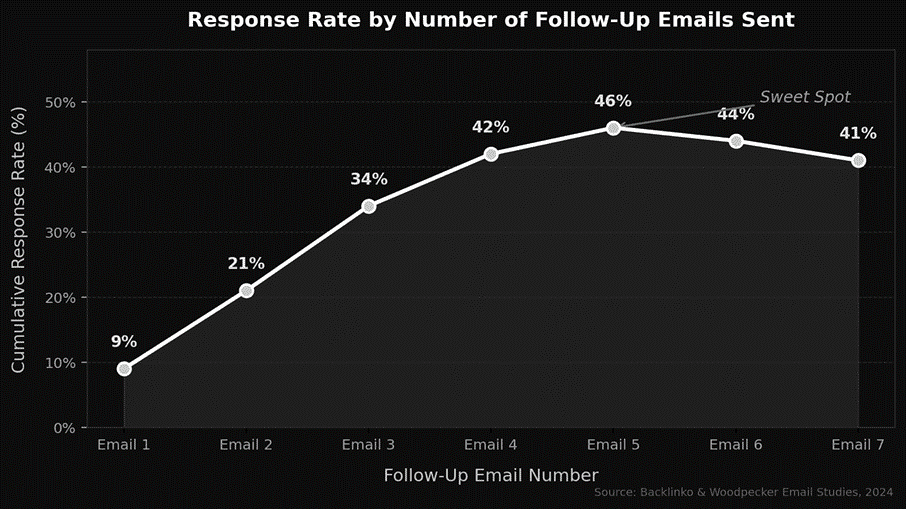
You should send between 3 and 5 follow-up emails for the best chance of getting a response. Research consistently shows that most replies come after the second or third follow-up, yet nearly half of salespeople never send even one.
That number might feel high at first. Most people worry about being annoying. But a Backlinko study found that sending multiple follow-ups can increase reply rates by up to 65%. Woodpecker's research confirmed that campaigns with 4 to 7 follow-ups received three times more responses than single-email campaigns. The people who follow up consistently close deals. The ones who stop after the first email leave money on the table.
Why Do Follow-Up Emails Matter So Much?
Your first email often lands at the wrong time. Prospects are busy, distracted, or not ready. A follow-up gives you another shot when conditions change. Here's why consistent follow-up works:
• 80% of deals require at least five touchpoints before closing, according to Marketing Donut research.
• The average professional receives over 120 emails per day, so your first message is easy to miss.
• Follow-ups signal genuine interest and persistence, two qualities that build trust with potential clients.
• Most competitors stop after one or two emails, so your later messages face far less inbox competition.
If you're running cold email campaigns for your startup, building a structured follow-up sequence is one of the fastest ways to improve your conversion rate without increasing spend.
What Is the Ideal Follow-Up Email Sequence?
Timing matters as much as the number of emails you send. Space your messages so they feel natural rather than aggressive. Here's a sequence that works well for B2B outreach and startup sales:
When to Send | Purpose | |
Email 1 | Day 1 | Initial outreach with a clear value proposition |
Follow-Up 1 | Day 3 | Gentle reminder with a new angle or resource |
Follow-Up 2 | Day 7 | Share a case study, result, or social proof |
Follow-Up 3 | Day 14 | Address a common objection or pain point |
Follow-Up 4 | Day 21 | Final check-in with a breakup-style message |
A structured approach like this removes guesswork. Each message has a job, and together they guide the prospect toward a decision. To learn more about writing emails that get replies, check out our guide on how to write a cold outreach email that gets replies.
What Mistakes Should You Avoid When Following Up?
Sending the same message every time. Each follow-up should bring something new, whether that's a fresh insight, a relevant resource, or a different angle on the prospect's problem.
Following up too soon. Emailing someone every day feels pushy. Give people at least 2 to 3 days between messages.
Ignoring subject lines. Keep them short, specific, and relevant. Generic subject lines get ignored faster than personalized ones.
Giving up after the first email. Nearly 44% of salespeople quit after one attempt. Respectful persistence separates results from silence.
Follow-up emails work best as part of a bigger strategy. Pairing them with a strong organic growth strategy ensures every touchpoint builds long-term brand visibility and trust, not just short-term opens and clicks.
The Bottom Line
Sending 3 to 5 follow-up emails is the sweet spot backed by data and real-world results. Space them out, add value in each message, and don't take silence as rejection. Most competitors stop too early, which means your persistence becomes your edge. If you want help building email sequences and marketing strategies that move the needle for your startup, visit Viral-Impact.
Let's talk about what growth looks like for your business.