Slow websites lose AEO visibility fast. Learn how page speed impacts AI citations, featured snippets, and search rankings.
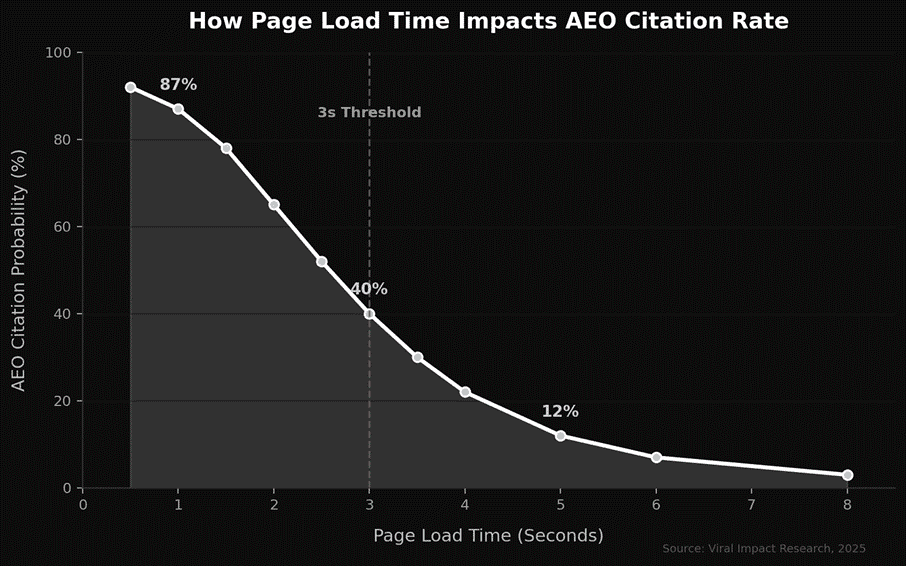
Website speed directly impacts your AEO visibility because AI engines prioritize fast-loading pages when pulling answers. If your site takes longer than three seconds to load, you are likely invisible to ChatGPT, Perplexity, and Google AI Overviews.
Why Does Page Speed Matter for Answer Engine Optimization?
Answer engines work differently from traditional search. They scan, extract, and cite the best answer in real time. Speed plays a massive role in that process.
• AI crawlers measure how fast your page responds. Slow response means they move on to the next source.
• Google uses Core Web Vitals as a ranking factor. Poor scores push your content below competitors in both search results and AI citation pools.
• Featured Snippets favor pages that load under two seconds. Slow pages rarely earn that position.
• High bounce rates from slow sites signal low quality to both Google and AI platforms.
Startups often overlook this. They spend weeks crafting blog posts, but forget that none of it matters if the page takes five seconds to render. Speed is the first filter.
What Speed Metrics Impact AEO Rankings the Most?
Not all speed metrics carry equal weight. Focus on these benchmarks:
• Largest Contentful Paint (LCP): Keep it under 2.5 seconds. Pages with poor LCP rarely appear in AI-generated answers.
• Time to First Byte (TTFB): AI crawlers have timeout limits. If your TTFB exceeds 800 milliseconds, crawlers may skip your page entirely.
• Interaction to Next Paint (INP): Tracks responsiveness across your page. Low INP scores correlate with higher engagement and stronger authority signals.
• Cumulative Layout Shift (CLS): Pages that shift during loading frustrate users and hurt your SEO and AEO growth strategy performance.
How Can Startups Fix Slow Website Speed for Better AEO?
Most startups can dramatically improve load times with a few practical changes:
• Compress images to WebP format and use lazy loading below the fold. This alone can cut load time by 40 percent.
• Remove unnecessary plugins, scripts, and third-party trackers. Every extra request adds latency.
• Use a content delivery network. CDNs serve pages from the closest server to each visitor, reducing TTFB dramatically.
• Minify CSS and JavaScript. Bloated code slows rendering and delays AI crawler access.
• Choose a performance-focused website design and development approach from day one. Fixing speed later costs three times more.
Does Mobile Speed Affect AEO Differently Than Desktop?
Yes. Google uses mobile-first indexing, meaning the mobile version of your site gets evaluated first. AI engines follow the same logic.
• Over 60 percent of searches happen on mobile. If your mobile page crawls, you lose the majority of potential AEO citations.
• Mobile users expect pages in under two seconds. Anything slower drives bounce rates up and credibility signals down.
• Responsive design is a ranking requirement. Startups investing early in mobile optimization see better results in startup SEO strategies and AI search visibility.
The Bottom Line
Website speed is not just a technical checkbox. It is the foundation of your entire AEO strategy. Slow pages get skipped by AI crawlers, buried by Google, and ignored by users. If your startup wants to appear in AI-generated answers and Featured Snippets, start by making your site fast.
Speed improvements are some of the highest-ROI changes you can make. A few hours of optimization can unlock months of compounding organic visibility.
Ready to make your website faster and visible to AI search engines? Visit viral-impact and let us build a speed-optimized growth strategy for your startup.