Learn what email warm-up is, why it matters, and how it protects your sender reputation effectively.
Email warm-up is the gradual process of increasing your sending volume from a new or dormant email account to build a trustworthy sender reputation. Without it, your outreach emails will land in spam folders, killing your response rates before you even get started.
If you have ever launched a campaign only to see zero replies and terrible open rates, your email account probably was not warmed up. This is one of the most overlooked steps in outreach. Whether you are a startup founder or a marketing team scaling campaigns, understanding warm-up is essential.
How Does Email Warm-Up Actually Work?
Email warm-up builds sending activity on a new or inactive account gradually. Instead of blasting hundreds of messages on day one, you start small and increase over weeks.
Start with 5 to 10 emails per day sent to engaged recipients who will open and reply.
Increase volume by 10 to 20 percent weekly as your sender reputation improves with Gmail and Outlook.
Encourage positive engagement like opens, replies, and emails moved from spam, which signals to providers that your messages are wanted.
Use a warm-up tool to automate interactions between real inboxes and speed up the process safely.
This teaches providers that your account is legitimate. Most successful cold email campaign strategies rely on this foundation to work at all.
Why Does Email Warm-Up Matter for Startups?
For startups, every lead counts. You cannot afford to burn through prospect lists because emails never reach an inbox.
• Protects your domain reputation. A damaged reputation takes months to recover, and some providers may permanently flag your domain.
• Boosts open rates by 40 to 60 percent compared to cold accounts that skip this step.
• Reduces spam complaints. Emails reaching the right inbox get fewer spam reports from recipients.
• Maximizes ROI on outreach tools. You already pay for software and data, so warm-up ensures that the investment pays off.
Startups pairing warm-up with a strong organic growth strategy tend to see much better results because both channels reinforce each other.
What Happens If You Skip Email Warm-Up?
Skipping warm-up is one of the fastest ways to derail outreach before it begins.
• Emails land directly in spam or promotions tabs, where almost nobody checks.
• Providers throttle or block your account after detecting unusual sending patterns.
• Your domain gets blacklisted, affecting every email from that domain,n including internal ones.
• Response rates drop below 1 percent, making your entire effort pointless.
Email Warm-Up Timeline at a Glance
Phase | Daily Volume | Deliverability | Focus Area |
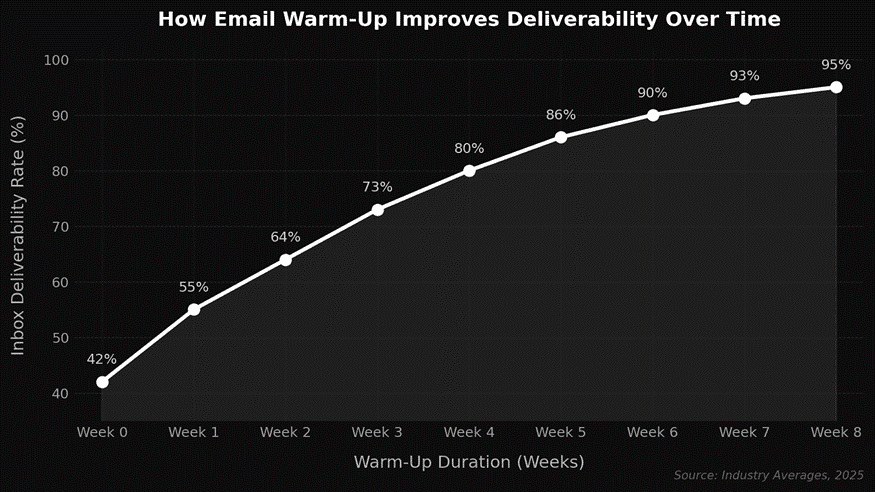
Week 1-2 | 5 to 15 emails | 42% to 64% | Personal emails, getting replies |
Week 3-4 | 20 to 40 emails | 73% to 80% | Mix of warm contacts and prospects |
Week 5-6 | 50 to 80 emails | 86% to 90% | Begin scaling cold outreach slowly |
Week 7-8 | 80 to 120 emails | 93% to 95% | Full campaign volume with monitoring |
How Long Does Email Warm-Up Take?
Most warm-up processes take 2 to 8 weeks,s depending on your sending goals. Accounts sending fewer than 50 emails daily can be ready in 2 to 3 weeks. If you plan to scale to hundreds of daily emails, expect the full 6 to 8 week timeline. Rushing this almost always backfires.
The Bottom Line
Email warm-up is not a hack. It is a necessary step separating successful outreach from campaigns that never leave the ground. If your startup relies on email to connect with prospects, skipping warm-up is not an option. Do it right, and your response rates will reflect that effort.
Ready to launch campaigns that actually reach inboxes? Visit Viral-Impact to see how we help startups build outreach systems that deliver measurable growth from day one.