Discover what product-led growth is and how it compares to sales-led growth for B2B SaaS companies in 2026.
Product-led growth (PLG) is a go-to-market strategy where the product itself drives user acquisition, activation, and expansion without relying on a dedicated sales team. Sales-led growth (SLG) flips that model, using salespeople to guide prospects through each stage of the buying process.
What Is Product-Led Growth?
PLG puts the product at the center of everything. Instead of waiting for a sales call to prove your value, users sign up, explore features, and experience results on their own. Think Slack, Notion, or Figma, nobody needed a pitch deck to start using them.
The core idea is straightforward: when people feel the value of your product early, they convert, stick around, and bring others with them. This cuts your customer acquisition cost and shortens the time from "just browsing" to "I need this."
Key features of a PLG model:
• Freemium or free trial access, no credit card required.
• Self-serve onboarding that guides users to their first win.
• In-product prompts that encourage upgrades.
• Usage-based pricing tied to real value delivered.
• Viral loops where users invite teammates or share work.
What Is Sales-Led Growth?
In a sales-led model, growth depends on human relationships. A prospect submits a demo request, a sales rep follows up, and a series of calls, proposals, and negotiations eventually leads to a closed deal.
This model works well for complex, high-value B2B software where buying decisions involve multiple stakeholders. Think enterprise contracts, security reviews, and procurement workflows.
Key features of an SLG model:
• Outbound prospecting and lead qualification.
• Structured demo and discovery calls.
• Long sales cycles often span several months.
• Custom pricing and contract negotiations.
• Customer success teams managing post-sale relationships.
PLG vs SLG: The Core Differences
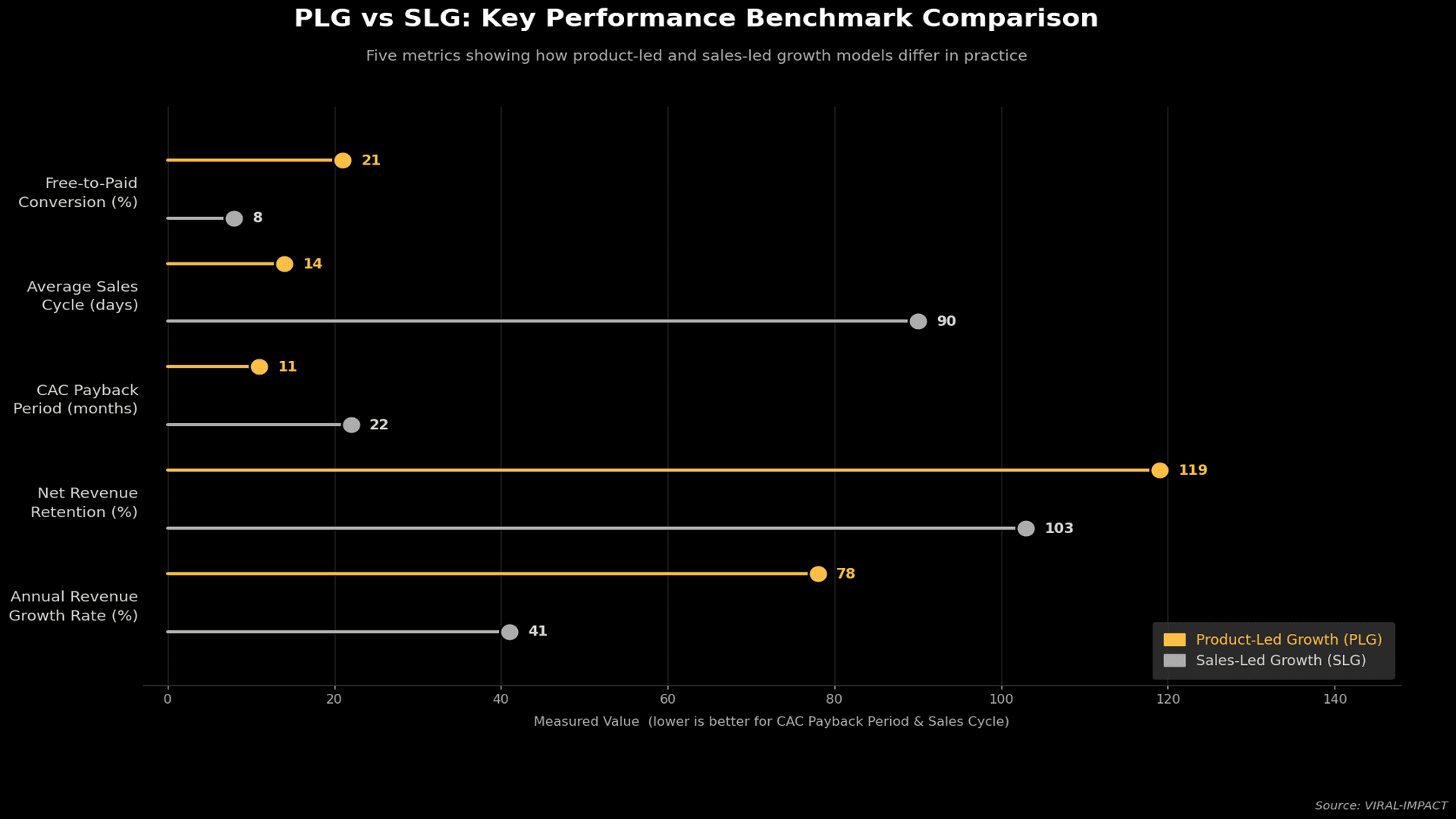
The two approaches are not mutually exclusive. Many growing SaaS companies start with PLG and layer in sales once deal sizes increase, a hybrid often called product-led sales.
Which Growth Model Is Right for Your Business?
The honest answer: it depends on your product complexity, target buyer, and price point.
PLG works best when:
• Your product solves a clear, immediate problem.
• Individual users can adopt it without IT approval.
• You have a strong free tier or a low-cost entry point.
• Collaborative features exist that encourage users to invite teammates.
SLG makes more sense when:
• Your average contract value is $20K or more annually.
• The product requires integration, training, or change management.
• Buying decisions go through procurement or legal teams.
• Trust-building over time is a core part of the sale.
Many early-stage SaaS teams default to sales-led because it feels more controllable. But this often leads to high CAC and slow scaling. Building an organic growth strategy in parallel reduces dependence on manual outreach from day one.
Why More B2B SaaS Companies Are Choosing PLG
Buyer expectations have shifted. People want to try before they commit. Sitting through a 45-minute demo just to discover a tool doesn’t fit their workflow is frustrating, and most buyers now skip that step entirely.
PLG also pairs well with content marketing. When your product is easy to access, and your search presence brings people in at the right moment, conversion happens without a sales rep in the room. Combining PLG with a strong SEO and AEO growth strategy creates a compounding acquisition engine that grows without proportionally adding headcount.
According to OpenView’s SaaS benchmarks, PLG companies grow roughly twice as fast as their sales-led counterparts while maintaining lower CAC through the scaling phase.
For more on building content systems that support this model, see Content Marketing for Startups.
The Bottom Line
PLG isn’t just a trend; it reflects how modern buyers actually behave. If your product delivers value quickly and independently, the PLG model cuts friction, reduces acquisition costs, and generates word-of-mouth.
SLG still wins where deal complexity demands it. The strongest SaaS companies learn to run both models, often simultaneously.
If you’re figuring out which growth approach fits your current stage, Viral-Impact helps you build the organic infrastructure to support it from SEO and content strategy to conversion optimization.