Learn what SEO is and how it works so your startup can rank on Google and grow faster.
SEO is the process of improving your website so it shows up higher in search engine results when people look for topics related to your business. It works by helping search engines understand, trust, and recommend your content to the right audience at the right time.
How Does SEO Actually Work?
Search engines like Google use crawlers to scan billions of web pages. They collect information, store it in a massive index, and use ranking algorithms to decide which pages appear first. The process follows three stages:
• Crawling: search engine bots discover your pages by following links across the web.
• Indexing: Google stores and organizes your content so it can retrieve it later when someone searches.
• Ranking: algorithms evaluate hundreds of factors to decide which pages best answer a given search query.
When your site is optimized well, search engines crawl it faster, index it accurately, and rank it above competitors. That's why having an SEO and AEO growth strategy in place from day one gives startups a serious edge.
What Are the Main Types of SEO?
SEO isn't one single task. It's a combination of approaches that work together. Here's how professionals break it down:
• On-Page SEO: optimizing pages with target keywords, headings, meta tags, and content that matches search intent.
• Off-Page SEO: building authority through quality backlinks from reputable websites, brand mentions, and social signals.
• Technical SEO: improving site speed, mobile responsiveness, crawlability, HTTPS security, and structured data markup.
• Local SEO: optimizing for location-based searches, especially valuable for businesses targeting specific regions.
Each type plays a different role, but they all serve the same goal: getting your pages in front of the right audience.
SEO Type | What It Covers | Key Actions | Impact Timeline |
On-Page SEO | Content, keywords, meta tags, headings, internal links | Keyword optimization, content updates | 2-4 weeks |
Off-Page SEO | Backlinks, brand mentions, social signals, PR | Link building, guest posting, outreach | 1-3 months |
Technical SEO | Site speed, mobile design, crawlability, HTTPS | Audits, schema markup, speed fixes | 1-6 weeks |
Local SEO | Google Business Profile, local citations, reviews | GMB setup, local directory listings | 2-8 weeks |
Why Does SEO Matter for Startups?
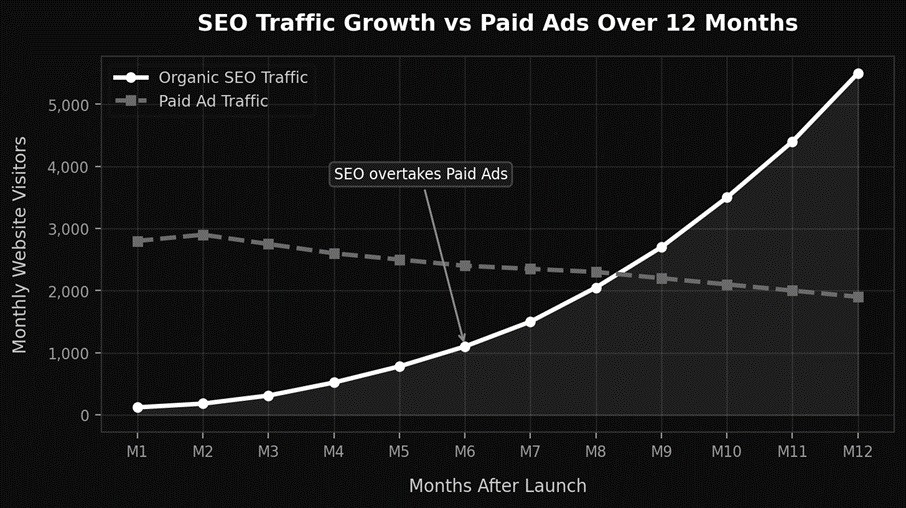
Most startups pour budget into paid ads without realizing that organic search drives over 53% of all website traffic. SEO lets you attract visitors without paying for every click:
• It builds long-term visibility that compounds over time instead of vanishing the moment you stop spending.
• It attracts high-intent visitors who are actively searching for the solutions you offer.
• It establishes trust and credibility because people naturally trust organic results more than advertisements.
Publishing well-optimized blog content on a consistent schedule and earning quality backlinks creates momentum that snowballs month after month.
How Long Does SEO Take to Show Results?
Most websites see meaningful improvements within three to six months of consistent work. Competitive industries may take longer, and timelines depend on domain age, content quality, and backlink strength. The key is treating SEO as a long-term investment.
If you're unsure where your website currently stands, running through a complete SEO audit checklist is one of the smartest first moves you can make. It pinpoints exactly what needs fixing, so every effort counts.
The Bottom Line
SEO is the foundation of every successful online growth strategy. It connects your website with people already looking for what you offer, without the ongoing cost of paid advertising. Investing in search optimization today sets your startup up for consistent, compounding growth tomorrow.
Ready to build a search strategy that actually moves the needle?
Visit viral-impact and let's talk about growing your startup the right way.