Learn actionable strategies to get your website mentioned in ChatGPT answers and increase your brand visibility in AI search.
Getting your website mentioned in ChatGPT answers comes down to building topical authority, publishing structured content, and earning trust signals across the web. When your content consistently answers specific questions better than competitors, AI models will reference your site as a reliable source.
If you have been wondering why some websites keep showing up in AI-generated answers while yours stays invisible, you ain’t alone. ChatGPT doesn’t randomly pick sources. It follows patterns, and once you understand them, you can position your website to get cited consistently.
This is where Answer Engine Optimization (AEO) becomes your biggest advantage. Unlike traditional SEO, which focuses on ranking blue links, AEO is about getting your content pulled directly into AI answers. Here is how to make it happen.
What Makes ChatGPT Cite a Website?
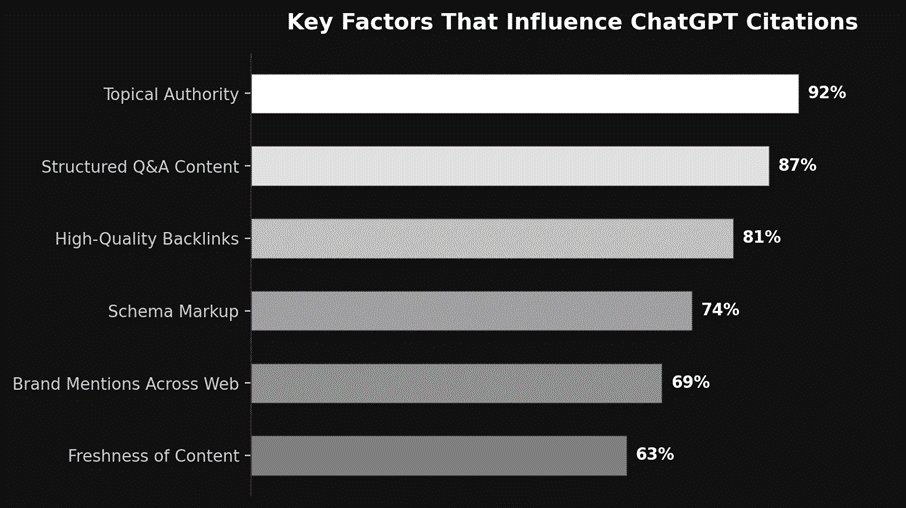
ChatGPT pulls information from patterns learned during training and, in browsing mode, from live web results. Websites that get cited tend to share a few common traits.
• They publish question-and-answer style content that directly matches how people phrase queries in conversational AI tools.
• They build deep topical authority by covering a subject from multiple angles with interlinked articles, not just one surface-level post.
• They earn quality backlinks and brand mentions from trusted publications, which signals credibility to both Google and AI platforms.
• They use schema markup (FAQPage, Article, HowTo) to make their content machine-readable, giving AI crawlers a clearer path to extract answers.
• They keep content updated and accurate, because outdated information rarely gets picked up by models that prioritize fresh, reliable data.
How Do I Optimize My Content for AI Answers?
Ranking on Google and getting cited in ChatGPT are not the same thing, but they share overlapping strategies. The key difference is structure. AI models prefer content that is organized, direct, and easy to parse.
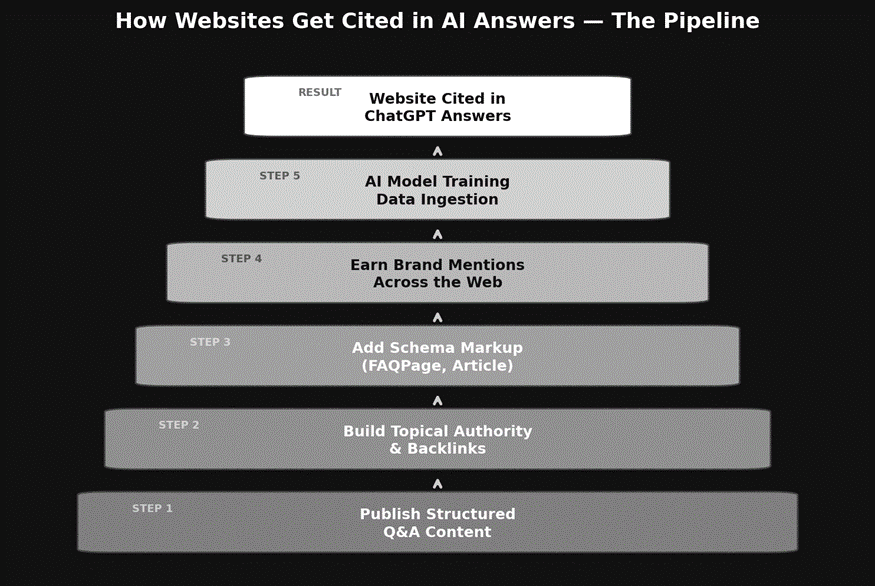
• Start every article with a 2–3 sentence direct answer right below the heading. Think of it as giving the AI exactly what it needs in the first few lines.
• Use question-based subheadings that mirror what real users type into ChatGPT, Google, and Perplexity.
• Build content clusters around one topic. Connect related blog posts, service pages, and guides through internal links so AI models see your site as an authority hub.
• Distribute your content through guest posts and PR placements on high-authority sites. This tells AI systems your brand is worth referencing.
Does SEO Still Matter for AI Search Visibility?
Absolutely. Strong SEO foundations still feed directly into AI citation potential. Google remains the primary training and retrieval layer for most AI tools. If your pages rank well and carry solid backlink profiles, AI models are more likely to surface your content. The difference now is that you also need to structure your blog posts for AI readability, not just human readers. That means adding direct-answer blocks, implementing schema markup, and writing in a way that is easy for machines to extract and quote.
The Bottom Line
Getting your website mentioned in ChatGPT answers is not about gaming the system. It is about becoming the most trustworthy and authoritative source on your topic. When you combine smart SEO with AEO strategies, build real topical depth, and earn credibility through backlinks, AI tools will naturally start referencing your content.
If you are a startup looking to get ahead of competitors in both Google and AI search, start building your content foundation today. Visit Viral-Impact to see how we help startups rank on Google and get cited by AI platforms like ChatGPT and Perplexity.