Learn how to choose brand colors that build trust, attract customers, and help your startup stand out online.
You choose brand colors by understanding your audience, your industry, and the emotions you want people to feel. The right palette builds trust, drives recognition, and quietly pushes people toward choosing you over competitors.
Most startup founders spend weeks on their product and about fifteen minutes picking brand colors. That’s a problem. Color is one of the first things a visitor notices on your website or social feed. Get it right, and you start building a connection before anyone reads a single word. This guide breaks it down; no abstract color theory, just what works. Need help getting your full brand identity and logo design dialed in? That’s always an option.
Why Do Brand Colors Matter for Startups?
Color is not decoration. People form opinions about a brand within 90 seconds, and up to 90% of that judgment is based on color alone. For startups fighting for attention, that matters.
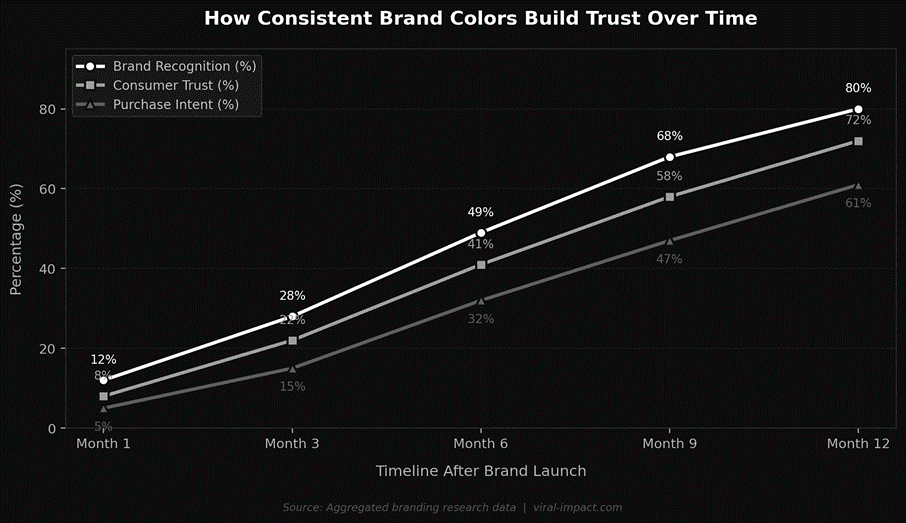
• Color increases brand recognition by up to 80%.
• Consistent colors across platforms build familiarity faster.
• The wrong palette can signal the wrong industry or emotion.
• Color consistency supports trust, and trust drives conversions.
What Steps Should I Follow to Pick Brand Colors?
This is not random. Follow these steps, and you will land on a palette that supports your marketing.
• Start with your audience: A B2B SaaS founder and a Gen Z shopper respond to very different palettes.
• Study your competitors: Note which colors dominate, then decide whether to align or stand apart.
• Pick one primary color: This is what people will associate with your brand. Match it to the emotion you want to carry.
• Add one or two supporting colors: These give flexibility for buttons, backgrounds, and accents.
• Include a neutral: White, dark gray, or black. Every palette needs breathing room.
• Test across platforms: What looks great on a monitor can wash out on a phone screen.
Your landing pages and website design depend on this foundation. Rushing it means retrofitting later.
Which Colors Work Best for Different Industries?
There is no universal answer, but patterns exist. Here is what branding professionals rely on.
Industry | Recommended Colors | Why It Works |
SaaS / Tech | Blue, Dark Gray, White | Signals trust and reliability |
Health / Wellness | Green, Teal, Soft White | Suggests calm and balance |
Finance / Fintech | Navy, Gold, Charcoal | Communicates security and authority |
E-commerce | Orange, Coral, Black | Drives energy and action |
Education | Purple, Blue, Yellow | Inspires curiosity and optimism |
Food / Hospitality | Red, Orange, Cream | Stimulates warmth and appetite |
These are starting points, not strict rules. The best brands understand the patterns and make the palette their own. If you want to dig deeper into how strong brand identity builds startup credibility, the psychology behind it is fascinating.
What Mistakes Should I Avoid When Choosing Brand Colors?
• Picking colors based on personal preference alone: Your favorite color might not resonate with your customers.
• Using too many colors: Stick to three to five total. More than that looks scattered.
• Ignoring accessibility: Low contrast between text and background pushes visitors away.
• Being inconsistent across platforms: Different shades on your website, social profiles, and emails create confusion.
The Bottom Line
Choosing brand colors is not about picking what looks pretty. It is about choosing colors that communicate the right message, connect with your audience, and support everything from your website to your social presence. Start with your audience, follow a clear process, and stay consistent. That is how color becomes a real growth tool.
If you are ready to build a brand that people recognize and remember, visit viral-impact and let us create something that actually moves the needle.