Learn how to find the right blog keywords that drive traffic, improve rankings, and attract your ideal readers.
Finding keywords for your blog starts with understanding what your audience searches for. The right research connects your content with the people actively looking for what you offer.
Keyword research is not about chasing popular words. It is about identifying the phrases your readers use and aligning them with their intent. When done well, your blog becomes a traffic source that delivers month after month.
Why Does Keyword Research Matter for Blog Success?
Without keyword research, you are writing blind. Here is why it matters:
• Search visibility: Keywords tell Google what your content covers, which decides where you rank.
• Audience alignment: The right keywords attract readers who care about your topic and might become customers.
• Content direction: Keywords reveal what questions people ask, giving you clear blog topic ideas.
• Competitive edge: Low-competition keywords let newer blogs rank faster against established sites.
Startups that invest in a robust SEO & AEO growth strategy see their content appear in both Google results and AI answers, doubling reach without doubling the budget.
How Do You Start Finding the Right Keywords?
You do not need expensive tools or years of experience. Follow these steps:
Brainstorm seed keywords: Write down 10 to 15 words your audience would search for related to your topic.
Use free keyword tools: Google Keyword Planner, Ubersuggest, and AnswerThePublic show search volume and related terms for free.
Check Google autocomplete: Type your seed keyword into Google and note the suggestions. These reflect real daily searches.
Study People Also Ask: Google's PAA section shows exact questions searchers want answered, perfect for blog topics.
Analyze competitor blogs: Check what keywords competing blogs rank for using Ahrefs or SEMrush.
Focus on long-tail keywords: Phrases with 3 to 5 words have less competition and better conversion rates.
If you want content that ranks consistently, pairing research with professional SEO blog writing ensures every article captures search traffic from day one.
What Makes a Good Keyword Worth Targeting?
Not every keyword deserves your time. Evaluate each one using these criteria:
Keyword Factor | What to Look For | Ideal Range | Why It Matters |
Search Volume | Monthly searches | 100 to 5,000 | Shows real demand |
Keyword Difficulty | Competition score | Under 40 | Easier to rank |
Search Intent | Informational or commercial | Matches your goal | Drives right traffic |
Relevance | Topic alignment | Directly related | Attracts ideal readers |
Long-Tail Potential | 3 to 5-word phrases | Specific queries | Higher conversions |
The sweet spot sits at moderate volume, low competition, and high relevance. A keyword searched 500 times monthly with low competition delivers more qualified traffic than a broad term searched 50,000 times.
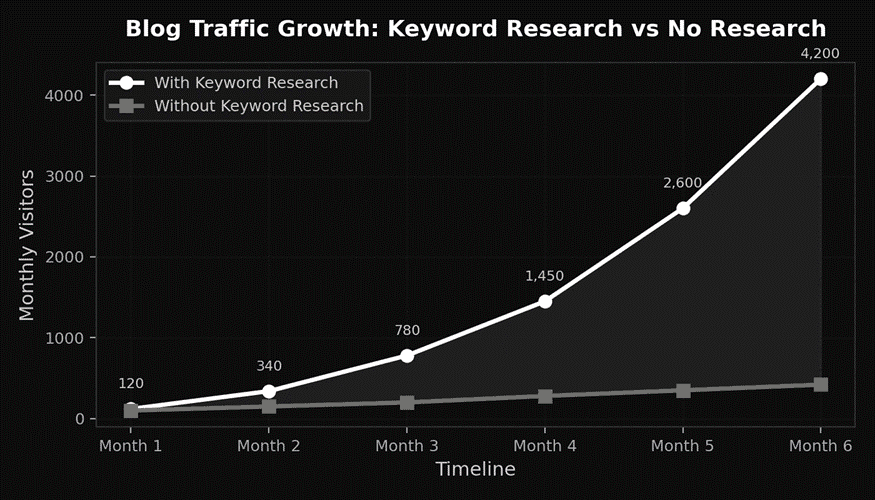
This growth gap shows why keyword research is not optional. Blogs built on researched keywords consistently outperform those written without a strategy.
How Do Keywords Improve Your AI Search Visibility?
AI search engines like ChatGPT, Perplexity, and Google AI Overviews pull answers from well-structured content. When your blog targets specific questions with clear answers, these platforms cite you more often.
• Use question-based headings that match how people ask AI tools for help.
• Answer directly in the first two sentences under each heading.
• Structure content with bullet points so AI can easily extract and summarize your information.
For a deeper dive into this topic, check out our guide on how to do keyword research for a new startup website.
The Bottom Line
Finding keywords for your blog is not complicated, but it requires a clear process. Start with what your audience searches, validate with tools, and target terms where you can realistically compete. When content matches real search intent, rankings follow.
Ready to build a blog strategy that drives traffic and clients? Visit Viral-Impact and let our team handle keyword research, content creation, and SEO that gets your startup found.