Learn how to build an SEO strategy that ranks on Google and gets cited by AI assistants like ChatGPT.
A strong SEO strategy for Google and AI assistants combines keyword optimization with structured, question-based content that AI tools can pull and cite. Format your answers clearly and add schema markup so you show up in search results and AI responses at the same time.
Why Does Your Startup Need a Dual SEO Strategy?
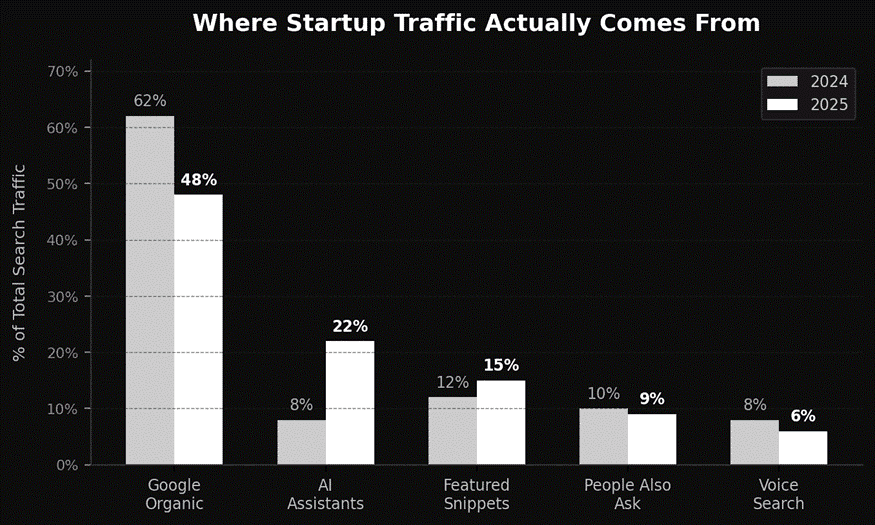
Google is still the biggest traffic source for startups. But AI assistants like ChatGPT, Perplexity, and Google AI Overviews are reshaping how people find information. If your content only targets traditional search, you miss the growing audience that gets answers from AI without clicking a link.
A dual strategy covers both channels. You rank on page one of Google while also getting cited in AI responses. That doubles your visibility without doubling your effort.
What Are the Key Steps to Build This Strategy?
Here is what works when you want to rank on Google and inside AI answers:
• Start with question-based keyword research. Use tools like AlsoAsked and AnswerThePublic. Target real search phrases as subheadings. AI tools pull directly from question-and-answer formats.
• Write direct answers first, then expand. Open every section with a clear two-sentence answer. This wins Featured Snippets and gets cited by AI search engines.
• Add schema markup to every page. FAQPage, Article, and HowTo schemas tell search engines and AI crawlers what your content covers. This directly increases your chances of appearing in AI-generated answers.
• Build topical authority, not just single keywords. Write clusters of related content around core topics. Google rewards depth. AI assistants prefer sources with demonstrated expertise.
• Earn high-quality backlinks. Domain authority matters for Google and AI tools cite sources that already rank well. Strategic SEO and AEO services can accelerate this process.
• Optimize for conversational search. People talk to AI like they talk to a friend. Use natural language, short sentences, and clear answers.
How Does Content Structure Affect AI Citations?
Structure matters more than ever. AI assistants scan pages for organized information they can extract. Messy or filler-heavy content gets skipped.
• Use H2 and H3 subheadings that match real search questions.
• Place your best answer in the first two sentences under each heading.
• Keep paragraphs under four sentences, so AI tools extract clean text blocks.
• Add an FAQ section with concise answers to improve People Also Ask visibility.
What Mistakes Should You Avoid With a Dual Strategy?
• Writing long, fluffy content that never answers the question. AI tools skip it, and Google ranks it lower.
• Ignoring schema markup. Without structured data, crawlers guess what your page covers.
• Treating SEO and AEO as separate projects. They work best when every piece of content serves both from day one.
• Chasing high-volume keywords without matching search intent. Wrong intent means no conversions, even if you rank.
The Bottom Line
You do not have to choose between Google and AI assistants. Start with question-based content, add schema markup, build backlink authority, and structure everything so it reads clean for humans and machines.
Ready to build a strategy that covers every search channel? Visit viral-impact and let our team build the growth engine your startup needs.