Discover which cold email patterns kill response rates and learn proven fixes to boost replies and conversions fast.
Generic subject lines, lengthy messages, and aggressive follow-up sequences are the cold email patterns most likely to reduce your response rates. Fixing these specific mistakes can double or even triple your reply rate within weeks.
Most startup founders spend hours crafting outreach emails that never get opened. The issue isn't your product or your market. It's the repeatable patterns in how those emails are written that push recipients straight to the delete button.
Which Cold Email Mistakes Kill Your Reply Rate?
These patterns consistently appear in campaigns with the lowest engagement:
Vague or clickbait subject lines: Phrases like "Quick question" or "Huge opportunity" feel manipulative and get ignored or flagged as spam.
Writing about yourself first: Opening with "I'm the founder of..." puts the spotlight on you, not the reader's problem.
Walls of text: Emails over 120 words see a sharp drop in replies. Nobody reads a five-paragraph pitch from a stranger.
No clear call to action: Ending with "Let me know your thoughts" gives zero reason to respond. A specific, low-effort ask works better.
Zero personalization: Blasting the same template without a personalized outreach strategy guarantees low engagement.
How Does Follow-Up Frequency Affect Response Rates?
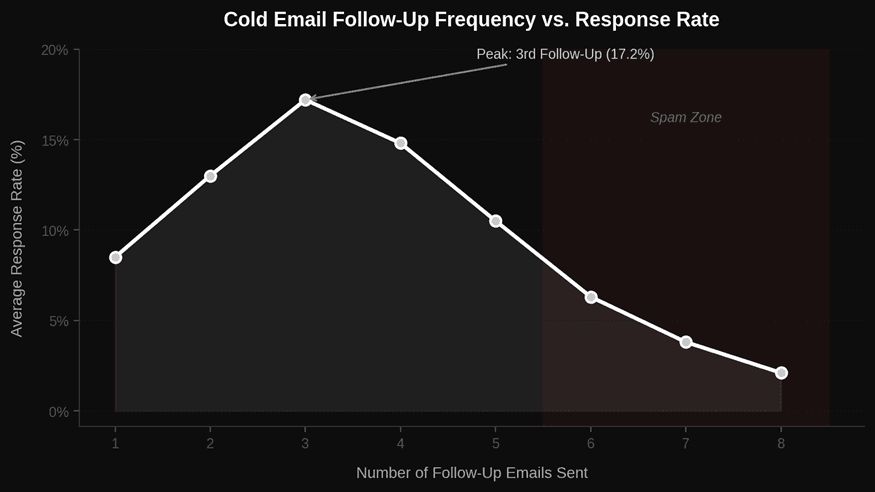
Follow-ups matter, but there's a clear tipping point. The third follow-up tends to generate the highest response rate. After that, each extra email delivers diminishing returns and risks damaging your sender reputation.
Space your follow-ups three to five days apart and cap sequences at four touches. Anything beyond that risks spam filters and permanent domain damage.
What Email Formatting Patterns Turn Readers Away?
How your email looks matters just as much as what it says:
HTML-heavy templates: Branded graphics scream "marketing blast." Plain-text emails feel personal and get opened more.
Multiple links or attachments: More than one link triggers spam filters. Attachments from strangers rarely get opened.
No mobile optimization: Over 60% of emails are read on phones. Dense formatting falls apart on small screens.
Working with a team that understands SEO and audience targeting strategy helps you write emails that feel targeted, not templated.
Cold Email Pattern Comparison: What Fails vs. What Works
Pattern | Mistake (Low Replies) | Fix (Higher Replies) |
Subject Line | Generic or clickbait phrasing | Specific and relevant to the recipient |
Opening Line | Talks about you first | Addresses the reader's pain point |
Email Length | 150+ words, dense paragraphs | 50-120 words, scannable format |
Call to Action | Vague or missing CTA | One specific, low-effort ask |
Personalization | Same template for everyone | Custom detail per recipient |
Follow-Ups | 7+ emails in rapid succession | 3-4 spaced 3-5 days apart |
Why Do Personalized Emails Outperform Templates?
Personalization goes deeper than inserting a first name. It means referencing the recipient's company, a recent achievement, or a shared connection. When readers see you did your homework, they're far more likely to reply.
Emails with personalized subject lines are 26% more likely to get opened. Startups that pair smart outreach with a solid blog content strategy see even better results because warm leads always convert more easily than cold ones.
The Bottom Line
Cold email still works when you strip away the patterns that kill engagement. Drop generic templates, stop writing essays, personalize every message, and make your ask impossible to ignore. The gap between a 2% and 15% reply rate often comes down to small, fixable mistakes.
Need expert help building outreach that converts?
Visit Viral-Impact and let our team design a cold email strategy built for startup growth.