Discover what question-answer format content means, why it boosts SEO and AEO, and how startups use it to rank.
Question-answer format content is a writing style where you structure articles around specific questions your audience asks, followed by clear and direct answers. This format helps search engines and AI platforms pull your content into featured snippets, People Also Ask boxes, and AI-generated responses.
Most startups struggle to get noticed online. They publish blog posts, hope for the best, and wonder why traffic never picks up. The missing piece is structure. When you format content around questions and answers, you speak the same language search engines use to match results with user intent.
When someone types a question into Google, the algorithm looks for content that directly answers it. If your article has that question as a subheading with a concise answer below, you have a much better chance of ranking.
Why Does This Format Work So Well for SEO?
Search engines reward content that quickly matches user intent. Here is why the Q&A format gives you an edge:
• Google’s algorithm favors direct answers placed right after question-based headings.
• Featured Snippets pull content that follows a clear question-answer structure.
• People Also Ask sections use the same pattern to display related answers.
• AI platforms like ChatGPT and Perplexity cite content structured in this way.
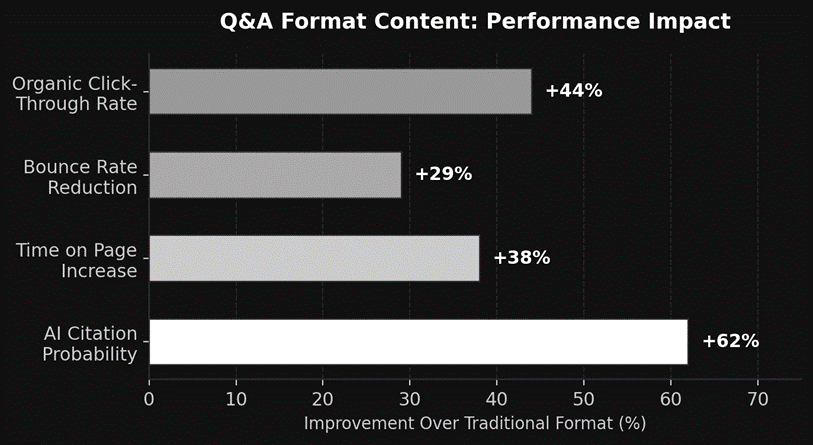
• Short, clear answers reduce bounce rates and keep readers on the page longer.
If you want your startup blog to compete, combining SEO blog writing with Q&A formatting is one of the smartest moves you can make.
How Do You Structure Question-Answer Content?
Building Q&A content requires a clear process:
• Start with keyword research to find the questions your audience actually searches
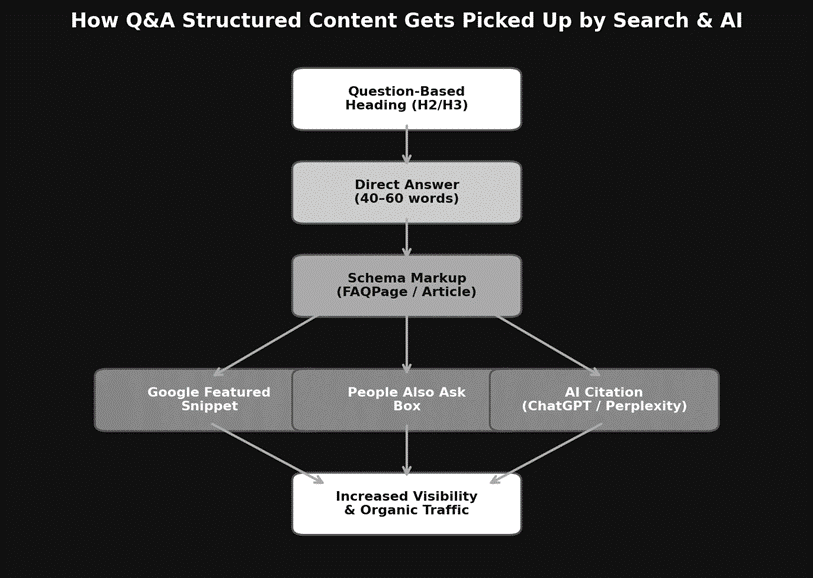
• Use those questions as your H2 or H3 subheadings.
• Write a 40 to 60-word direct answer immediately after each question heading.
• Expand with supporting details, examples, or bullet points below.
• Add internal links that naturally connect to related topics.
Every section should be independently useful. Each question and answer must stand on its own while fitting into the larger piece.
Does Q&A Format Help with AI Search Engines?
Absolutely. AI platforms are trained to identify well-structured content. When your article uses clear question headings and concise answers, AI tools extract and cite your content more easily.
This is the foundation of answer engine optimization. Instead of writing for humans alone, you structure content so both people and machines can process it efficiently. The result is better visibility across Google, ChatGPT, Perplexity, and Google AI Overviews.
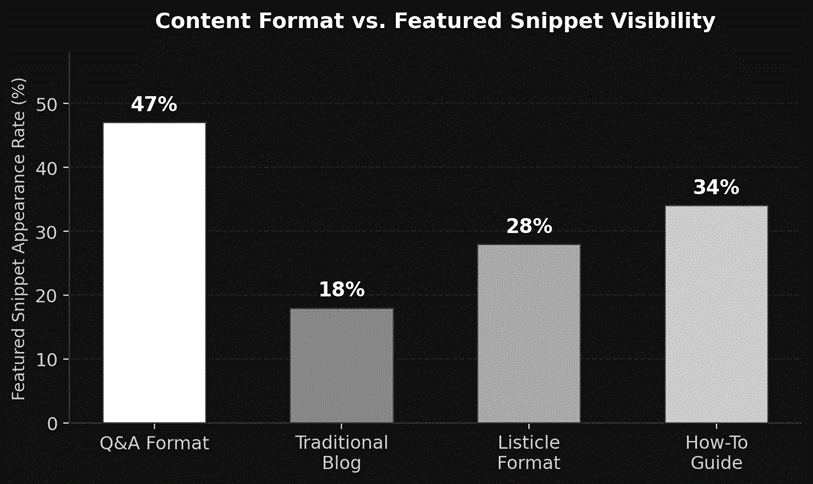
Pages with Q&A structured content see up to a 47% increase in featured snippet appearances compared to traditional blog formats. Startups that adopt this approach early gain a clear competitive advantage in organic search.
What Mistakes Should You Avoid?
Even a good format can fail if executed poorly. Watch out for these common pitfalls:
• Writing vague answers that do not directly address the question.
• Stuffing too many keywords into your question headings.
• Making answers too long, which causes search engines to skip them.
• Ignoring schema markup that signals your content structure to Google.
• Forgetting to link related topics within your site.
Your content should feel like a natural conversation, not a keyword-stuffed FAQ page. If you need guidance on balancing structure with readability, check out this guide on how to create a blog content strategy that drives traffic.
The Bottom Line
Question-answer format content is not a passing trend. It is how modern search works. When you structure articles around audience questions and provide clear answers, you improve your chances of ranking on Google, getting cited by AI, and driving real traffic to your startup.
If you want to build a content strategy that works across search engines and AI, visit Viral-Impact and let us help you create content that ranks, converts, and grows your brand.