Learn what speakable schema is, how it works, and why it directly improves your overall AI search visibility.
Speakable schema is structured data markup that tells AI tools and voice assistants which page sections contain your most direct, answer-ready content. Platforms like Google Assistant, AI Overviews, and Perplexity use those marked sections to generate spoken or AI-powered answers, putting your content in front of the user instead of a competitor's.
What Does Speakable Schema Actually Do?
Most web pages mix useful content with navigation, sidebars, legal text, and filler. When an AI tool scans your page, it has no built-in way to identify which paragraphs answer a user's question. Speakable schema fixes that by flagging the sections most suitable for voice and AI responses.
Without it, AI systems either skip your page or grab the wrong section, an intro line, a sidebar snippet, or a generic description. With it, you hand AI a precise map of where your best content lives. That's the practical value: it removes algorithmic guesswork and directly benefits your visibility in voice results and AI answer panels.
How Speakable Schema Works
Speakable schema uses the SpeakableSpecification property from schema.org. You add it as a JSON-LD block, pointing to content sections by CSS selector or XPath expression.
The sections most worth marking:
Short definitions or summary answers near the top of the page.
Step-by-step instructions that answer how-to questions directly.
Self-contained FAQ answers written in plain, factual language.
The rule that matters most: only mark content that stands on its own. AI tools read those sections verbatim or cite them directly. If a passage needs surrounding context to make sense, leave it out of the markup.
Why Speakable Schema Matters for AI Search
Search behaviour has shifted in ways most content teams haven't kept up with. AI Overviews appear in over 40% of Google results. Perplexity, ChatGPT, and Gemini now pull from live web pages to generate answers. If your pages aren't structured to meet that demand, they get passed over entirely.
A properly built SEO and AEO growth strategy accounts for exactly this shift. Here's what speakable schema adds to your visibility:
Raises the chance that Google Assistant reads your content aloud in a voice query response.
Signals to AI Overviews that your page is structured for direct citation, not just general browsing.
Improves Featured Snippet eligibility, the page signals a clear, organised, answer-formatted structure.
Reduces the risk of an AI tool pulling a vague or misleading section from your page.
Pages without speakable markup rely on general signals alone. Pages with it give AI a clear directive.
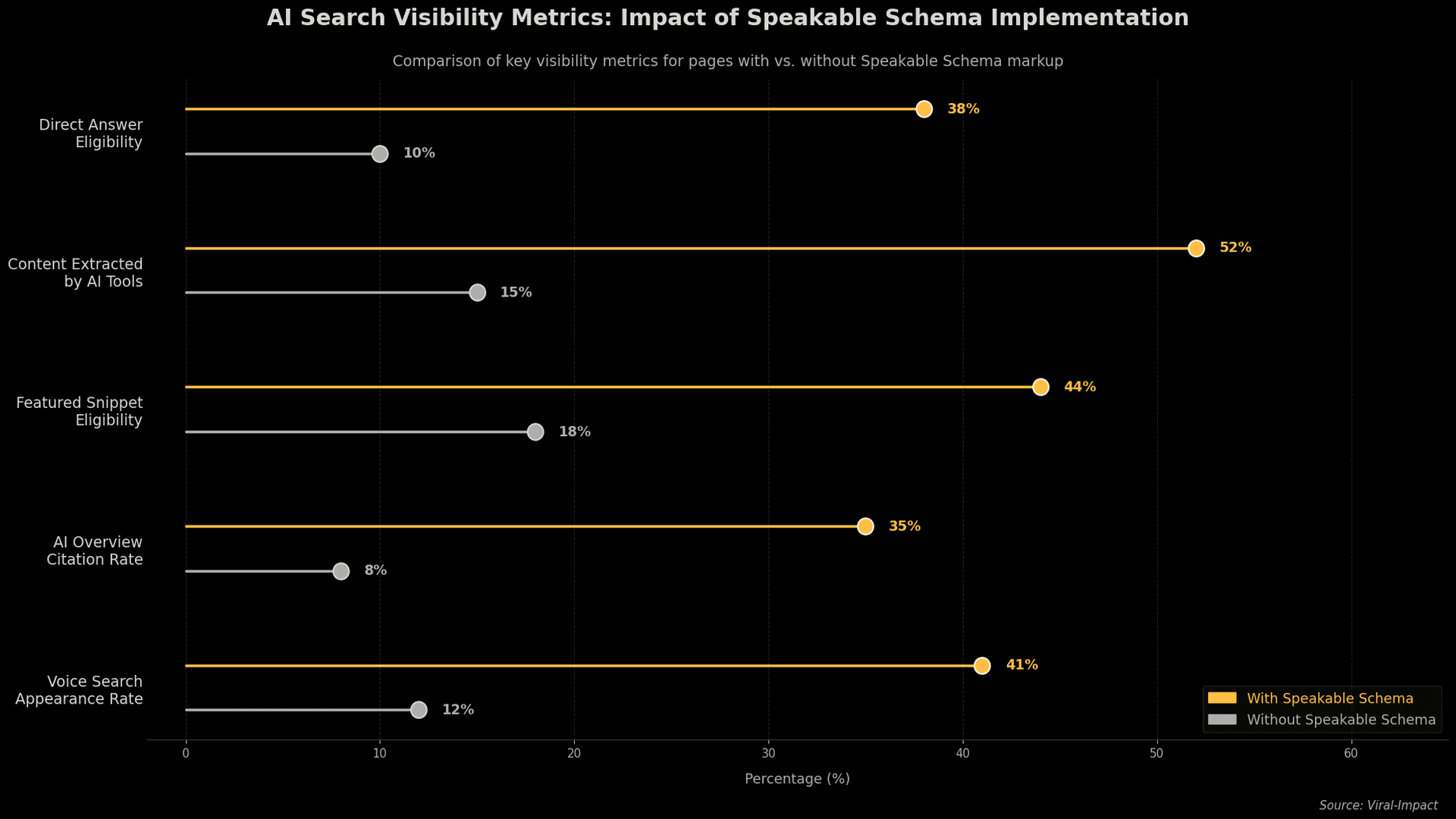
Speakable Schema vs. Standard Schema
Feature | Standard Schema | Speakable Schema | Why It Matters |
|---|---|---|---|
Purpose | Describes page type | Flags text for AI & voice | AI tools know what to cite |
AI citation impact | Indirect | Direct | Higher citation rate |
Voice search benefit | Minimal | High | Audio answer eligibility |
Best used on | All pages | FAQs, guides, blogs | Question-answering content |
Who Should Use Speakable Schema?
Originally written for news publishers, the spec works just as well for any site producing informational content:
SaaS companies with product explainers or resource library pages.
B2B service businesses running knowledge bases or help centres.
Startups building content authority before organic rankings develop.
Blogs and resource hubs are built around definitions, guides, and FAQs.
If you're already producing AEO-optimised blog content to target featured snippets and People Also Ask, speakable schema reinforces that work directly. It's the natural technical complement to content already built for answers.
How to Implement Speakable Schema
Identify 2–3 sections that clearly and directly answer a user question
Keep each section under 150 words, written in plain, direct language
Add the SpeakableSpecification block as JSON-LD inside your page's <head> tag
Reference those sections using CSS selectors or XPath expressions
Validate using Google's Rich Results Test, fix any warnings before publishing
Combine with FAQ, Article, and HowTo schema for maximum AI coverage
For a broader look at how AI tools decide what to cite from schema to content structure, the guide on getting cited in AI search results is worth reading before you start.
The Bottom Line
Speakable schema is one of the smallest technical changes you can make with one of the clearest payoffs in AI and voice search. If your site publishes informational content and you want it to show up in AI-generated answers, this is a direct step you can take today. Visit Viral-Impact to learn how our team helps SaaS companies and startups build structured, AI-ready content that earns consistent visibility where search is heading.