Learn what Bing Copilot is, how it chooses content to show, and why that matters for your SEO.
Bing Copilot is Microsoft's AI-powered search assistant that generates direct answers by pulling from indexed web pages. It evaluates sources for structure, authority, and relevance, then delivers one synthesized response instead of a list of links.
What Is Bing Copilot, Exactly?
Bing Copilot (launched as Bing Chat in 2023) runs on GPT-4, built by OpenAI and integrated directly into Microsoft's search engine. When you ask it a question, it doesn't just return ten blue links. It reads multiple sources, stitches the most relevant information together, and responds in plain, conversational language.
You'll find it at bing.com/chat and built into Microsoft Edge, Windows 11, and Microsoft 365. Millions of people now type full questions into Copilot rather than search keywords into a bar. That behavioral shift matters because it changes which content gets found and which gets ignored.
How Does Bing Copilot Decide What to Show?
Copilot combines Bing's existing search index with real-time web retrieval. When a user asks a question, the system follows this process:
• Searches for authoritative, relevant pages already indexed by Bing
• Pulls excerpts that answer the query directly
• Cross-checks multiple sources for consistency and accuracy
• Generates a synthesized response, often with clickable citations
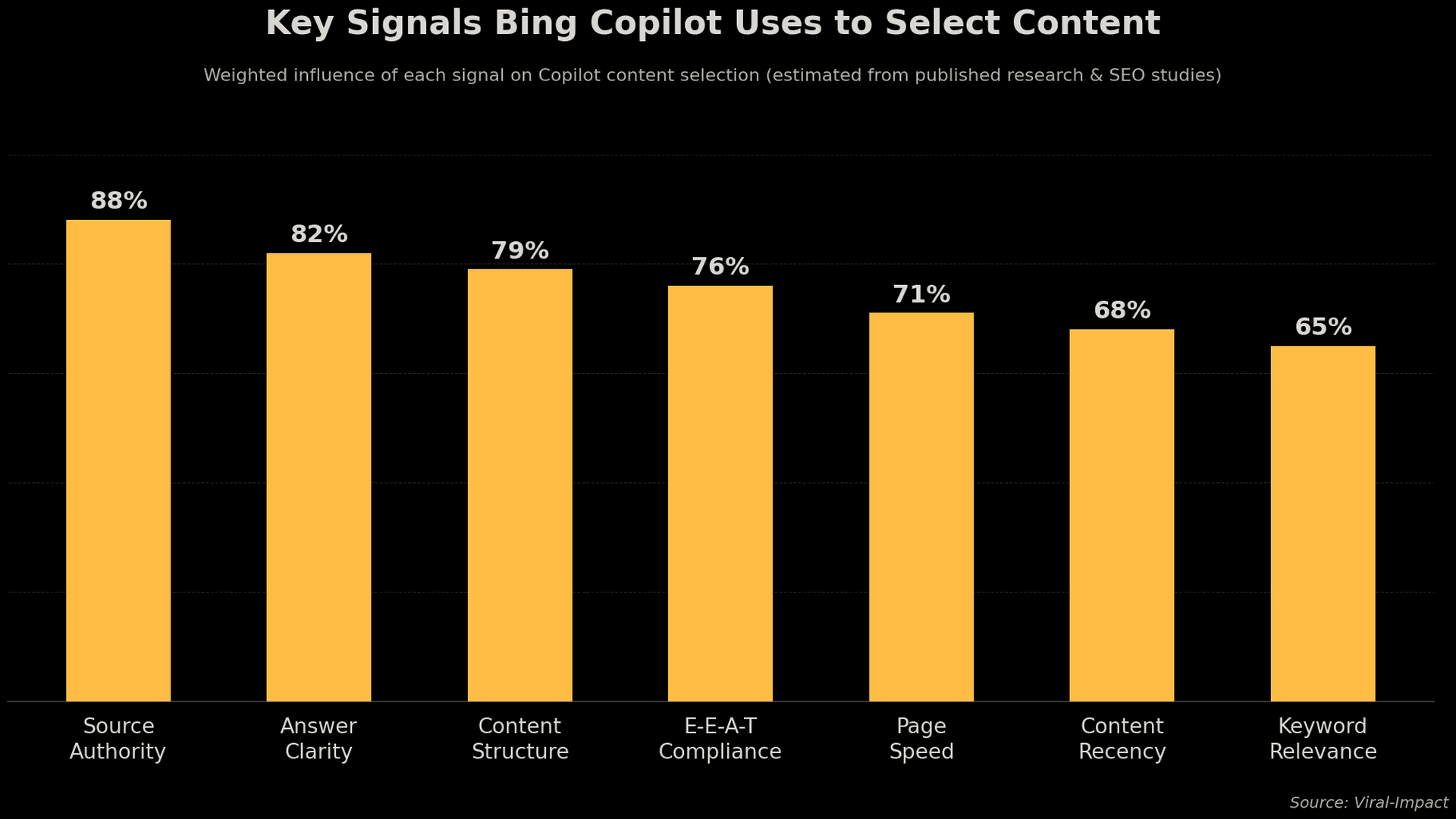
Content selection isn't random. Copilot pulls pages that answer clearly, load fast, and are well-structured. The main signals that influence what gets pulled include:
• Domain authority: established, well-linked domains are trusted more
• Content structure: clear H2/H3 headings and short paragraphs are easier to parse
• Answer placement: Copilot prefers pages that answer the question in the first 100–150 words
• Recency: for fast-moving topics, fresher pages have an edge
• E-E-A-T compliance: Experience, Expertise, Authoritativeness, and Trustworthiness still carry heavy weight
What Kind of Content Gets Picked by Bing Copilot?
Certain formats consistently appear in Copilot responses. The types that get cited most often are:
• FAQ-style pages that match natural question patterns
• Definition articles that explain a concept in plain terms
• How-to guides with clear step-by-step structure
• Data-backed content with statistics and cited sources
• Press coverage and news for trending or time-sensitive queries
If your content is a wall of text with no subheadings, no clear answers, and no structure, Copilot will skip it. That's the core principle behind AEO writing. Structuring content so AI tools can read and use it.
Why Does Bing Copilot Matter for Your SEO Strategy?
Bing has over 900 million active users worldwide. With Copilot now embedded in Windows and Edge by default, that audience is growing. If your content doesn't appear in Copilot responses, you're invisible to a significant portion of potential buyers.
This is where a combined SEO & AEO strategy becomes necessary. Ranking on Bing and getting cited by Copilot require two overlapping efforts: building traditional search authority and structuring content for AI extraction. Startups that combine both are already capturing traffic from traditional search and AI-driven queries at the same time.
For a step-by-step breakdown, read our guide on 7 steps to get cited in AI search results.
How Can You Optimize Your Content for Bing Copilot?
The checklist is shorter than most people expect:
• Put the direct answer in the first 150 words
• Frame H2 and H3 subheadings as natural questions
• Keep paragraphs to 3–4 lines maximum
• Use bullet points to break down multi-part answers
• Add author credentials and clear publication dates
• Build backlinks from authoritative, relevant domains
• Keep page load speed under 3 seconds
None of these changes requires a big budget. They require a consistent, repeatable content process, and that's where most startups fall short.
The Bottom Line
Bing Copilot is now one of the primary ways people get answers online. It selects content based on structure, authority, and how directly a page answers the question. If you want your brand to show up in those responses, your content needs to be built with AI readability in mind, not just keyword density.
Viral Impact helps startups and B2B companies build content that ranks on Google and gets cited by platforms like Bing Copilot. Visit Viral-Impact to start building your AI-search presence today.