Discover how Google AI Overviews are reshaping search optimization and what startups must do to stay visible online.
Search optimization after Google AI Overviews will center on structured answers, entity authority, and multi-platform visibility. Startups that adapt early will capture traffic that competitors lose to zero-click results.
How Do Google AI Overviews Change Search Results?
Google AI Overviews pull direct answers from trusted sources and display them above traditional organic links. This changes how users interact with search entirely.
• Organic click-through rates drop because users get answers without clicking.
• Content earning AI citations gains visibility that traditional rankings cannot match.
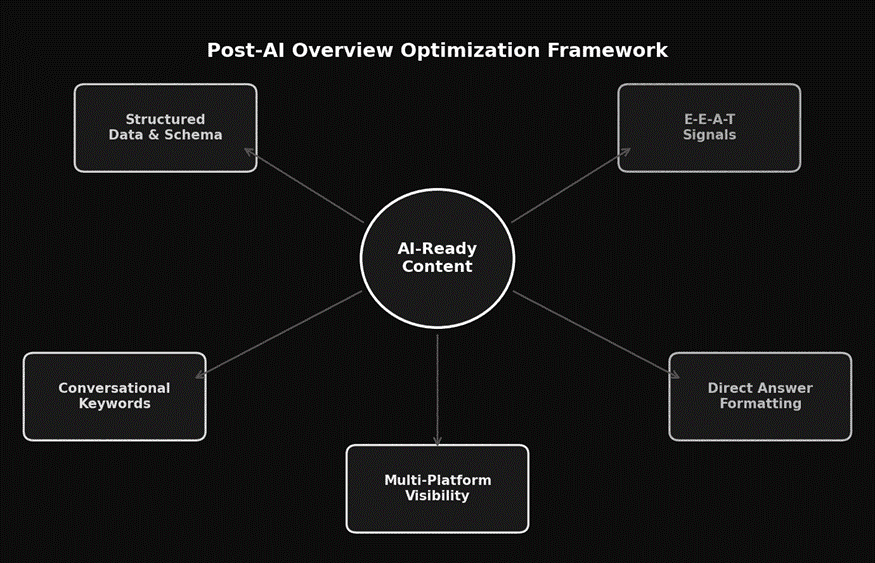
• Structured data and schema markup become essential signals, not optional extras.
• E-E-A-T signals carry more weight as Google verifies which sources deserve citations.
The shift does not kill SEO. It forces it to evolve. Brands chasing keyword rankings without adapting content structure will lose ground fast.
What Should Startups Prioritize for Post-AI Search?
The biggest mistake right now is treating AI Overviews as a threat instead of an opportunity. Brands that restructure content for AI citations will dominate the next era of search.
• Write clear, direct answers within the first 40 words of each section.
• Use the FAQ schema, Article schema, and HowTo schema so search engines understand your content.
• Build topical authority through content clusters around your core expertise.
• Target conversational long-tail keywords matching how people actually ask questions.
• Optimize for answer engines beyond Google, including ChatGPT and Perplexity.
A strong AEO blog writing strategy helps structure content that both search engines and AI platforms can cite. This is a competitive necessity now.
Does Traditional SEO Still Matter After AI Overviews?
Absolutely. Traditional SEO is the foundation that makes AI optimization possible. Google AI Overviews still pull from pages that rank well organically. Without strong technical SEO and clean site architecture, your content will not qualify for AI citations.
• Backlink profiles and domain authority still influence which sources AI Overviews cite.
• Page speed, mobile responsiveness, and Core Web Vitals remain critical ranking factors.
• Keyword research evolves toward question-based and intent-driven queries.
• Content clarity and answer precision matter more than content length.
A solid SEO and AEO growth strategy gives startups the technical foundation to rank across both traditional and AI-driven search.
How Can Startups Stay Visible in AI-Driven Search?
Visibility in 2026 requires a multi-channel approach. Relying on a single ranking position no longer works.
• Audit existing content and add direct answer blocks at the top of each section.
• Implement structured data markup on every key page, especially FAQs and how-to pages.
• Create content that earns AI citations by answering questions clearly and factually.
• Build authority through guest posts, press coverage, and consistent publishing.
• Track performance across Search Console, AI citation tools, and platform analytics.
For a deeper look at structuring content for AI citations, read this guide on getting cited in AI search results. It covers the exact steps that work right now.
The Bottom Line
Google AI Overviews are not a passing trend. They represent a permanent shift in how search results work. Startups that adapt now will capture the visibility that slower competitors lose.
The brands winning in 2026 combine strong technical SEO with AI-ready content structures. Do not wait for rankings to drop before making changes.
Ready to future-proof your search visibility? Visit viral-impact and let our team build a strategy that works across every search platform.