The Follow-Up Sequence That Gets Responses Without Annoying
The most effective follow-up sequence pairs strategic timing with value-driven messaging to move cold prospects toward a response. A well-structured four to five-touch cadence can more than double reply rates without damaging relationships or your sender reputation.
Most salespeople send one cold email, hear nothing, and either quit or send the same message with a different subject line, but neither works. The first abandons most potential replies that arrive after the initial, and the second trains prospects to treat your name as noise.
Getting responses from cold outreach is not purely about volume. It requires showing up at the right moment with a message that earns a reply rather than demands one. If your team is still refining the first email, our guide on Cold Outreach covers that foundation before this sequence begins.
Table 1: Cold Email Sequence Performance by Length
Sequence Length | Avg Reply Rate | Replies from Follow-Ups |
1 email only | 9% | 0% |
2 to 3 emails | 13% | 31% |
4 to 7 emails | 27% | 66% |
8+ emails | 29% | 72% |
Source: Woodpecker Cold Email Study, 2024
Why Most Follow-Up Emails Fail
The problem is not frequency. Most follow-up emails fail because they offer nothing new. Sending "Just checking in" three times provides no incentive to respond and signals you have run out of ideas.
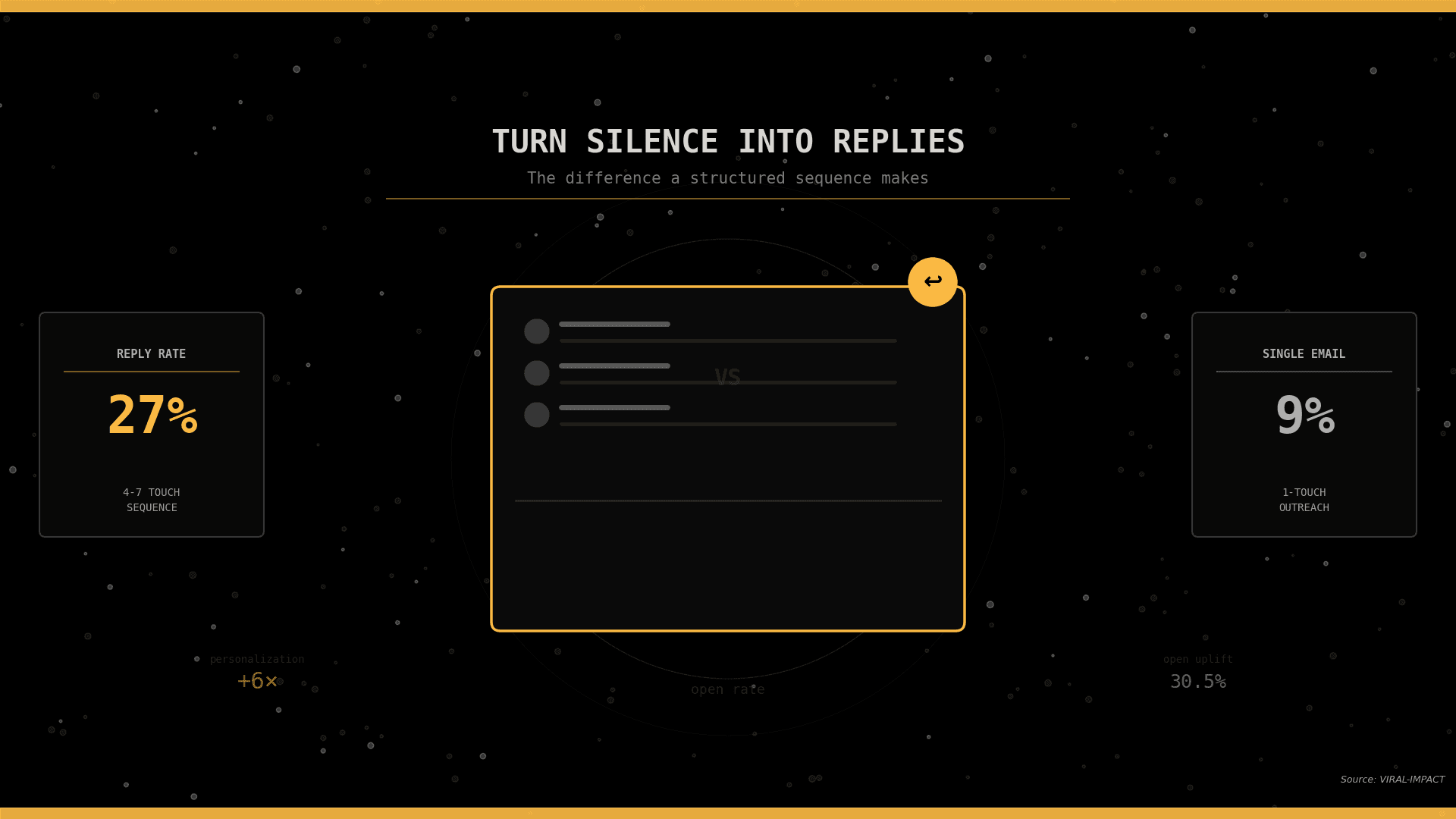
Woodpecker's cold email research shows sequences with 4 to 7 touches achieve a 27% reply rate, compared with just 9% for single-touch outreach. Those numbers hold only when each follow-up introduces a fresh angle. Repetitive messages that restate the same ask see rapidly diminishing returns after touch two.
Other patterns that consistently hurt response rates:
• Sending follow-ups too quickly, which signals desperation rather than confidence.
• Writing subject lines that reference the previous email instead of standing independently.
• Closing every message with a high-commitment ask like "Can we book 30 minutes?"
• Missing specific relevance to the prospect's role or actual business situation.
• Leaving no graceful opt-out path for prospects who are not interested.
The Psychology Behind Effective Follow-Ups
Understanding why people respond helps you write messages they want to answer. Reciprocity is one of the most reliable drivers in B2B sales. When you offer something genuinely useful, even a short insight or a relevant resource, prospects feel a pull toward acknowledging it.
Pattern interruption matters too. Most follow-up sequences look identical: same structure, same ask, same format. A message that breaks that mold, whether shorter, blunter, or different in tone, gets noticed because it does not match expectations.
According to HubSpot's research, personalized emails that reference something specific about the recipient generate 6x higher transaction rates than generic outreach. In follow-ups, that specificity matters even more because your first email already covered the broad pitch.
The Proven Follow-Up Sequence Step by Step
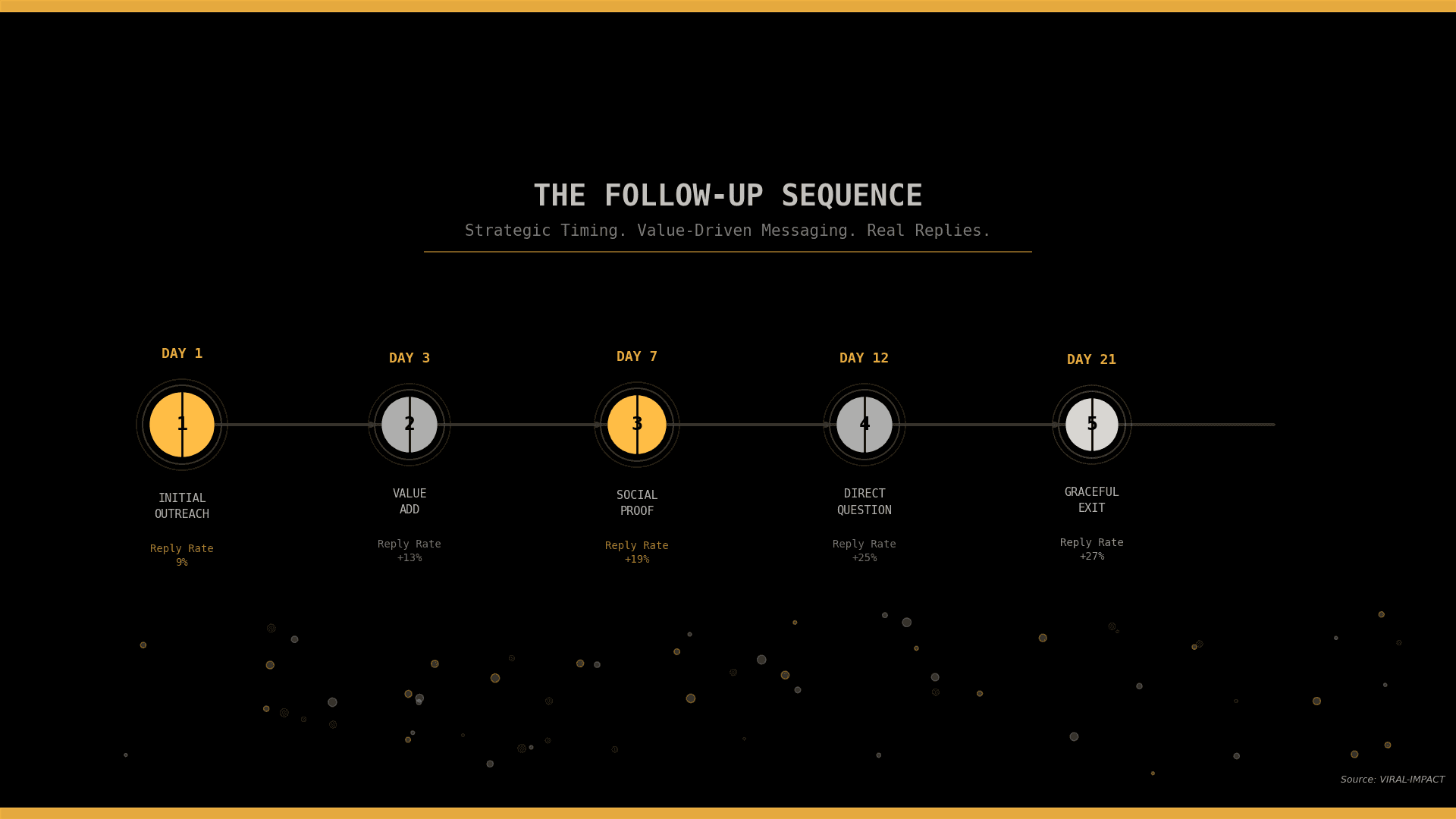
A high-performing sequence runs 4 to 5 touches across 2 to 3 weeks. Each message needs a distinct purpose:
1. Email 1 (Day 1): Lead with a specific observation about their business, state the problem you solve, and include one low-friction ask. Keep it under 120 words.
2. Email 2 (Day 3): Skip rehashing the first message. Share a relevant resource or data point tied to their situation and ask whether the problem is still on their radar.
3. Email 3 (Day 7): Mention a specific outcome you have driven for a comparable company. Keep the ask low-commitment: "Would this be worth a quick 10-minute conversation?"
4. Email 4 (Day 12): Try a completely different approach. A short, plain-text email with one focused question about their workflow often breaks through when longer emails have not.
5. Email 5 (Day 21): Make clear this is your final message, but leave the door open. A graceful exit consistently generates replies from prospects who were interested but had not yet responded.
For teams managing high-volume prospecting, a structured Email Outreach system automatically embeds these principles into every cadence.
Timing Your Follow-Up Sequence Right
Send timing affects open and reply rates more than most senders realize. Tuesday through Thursday mornings between 8 am and 10 am consistently produce the strongest B2B results regardless of industry.
Table 2: Optimal B2B Email Send Times
Day | Best Window | Avg Open Rate | Avg Reply Rate |
Monday | 10 am to 11 am | 22% | 5.1% |
Tuesday | 8 am to 10 am | 31% | 7.3% |
Wednesday | 9 am to 11 am | 29% | 6.8% |
Thursday | 8 am to 10 am | 30% | 7.1% |
Friday | 9 am to 10 am | 20% | 4.2% |
Source: Woodpecker Cold Email Analysis, 2024
What to Write in Each Follow-Up
Every follow-up needs its own hook. Repeating the same email with a new subject line signals low effort. The most effective content approaches by touch:
• Resource sharing: Send a relevant article or framework your prospect would actually use. One sentence explaining why you thought of them is enough.
• Social proof: Reference a specific outcome you have driven for a company in their industry. Concrete numbers carry more weight than general claims.
• Challenge-focused: Name a specific problem you suspect they are dealing with and offer one practical suggestion with no strings attached.
• Short and direct: A two-sentence email with one easy-to-answer question lowers the barrier to reply dramatically.
• The breakup: A final message acknowledging you will not follow up again often prompts responses from prospects sitting on the fence.
Pairing outbound sequences with content that warms prospects first makes every touch more effective. Our Organic Growth strategy service helps B2B companies build that inbound foundation alongside their outreach efforts.
Mistakes That Make Follow-Ups Feel Pushy
Even well-designed sequences fail when small execution errors undermine credibility. The most common:
• Following up within 24 hours creates unnecessary pressure and signals you have no other active conversations.
• Guilt-based language like "I haven't heard back from you" reads as passive-aggressive and damages rapport from the second touch onward.
• Copy-pasting the same email with a new subject line is easy to spot and guarantees declining response rates throughout the sequence.
• Every follow-up needs a hook. Without a question, a resource, or a fresh angle, you are asking prospects to respond to nothing of substance.
• Removing the opt-out path forces disinterested prospects to ignore you, which harms your sender reputation over time.
Automating Without Losing the Human Touch
Tools like Lemlist, Instantly, Woodpecker, and Apollo enable full sequence automation while preserving space for personalization. According to Backlinko's email outreach research, personalized subject lines increase open rates by 30.5% and personalized body content lifts reply rates by 32.7%.
The key is writing templates that read like individual messages. Avoid merge tags that produce awkward constructions, test on a small sample before scaling, and ensure your system removes anyone who replies immediately.
When sequences are paired with strong inbound content, results compound. Prospects already familiar with your brand reply at noticeably higher rates. Our SEO Blog writing builds that recognition before outreach begins, and our Landing Page copywriting converts the leads your sequence generates once they arrive.
FAQs
Q1:How many follow-ups should I send before stopping?
Research consistently points to 4 to 5 follow-ups as the optimal range. Sequences with 4 to 7 touches achieve roughly 27% reply rates according to Woodpecker's study data. Beyond 7 messages, returns diminish, and sender reputation risks increase.
Q2:How long should a follow-up email be?
Shorter is almost always better, especially after the second touch. Follow-ups 3 through 5 should ideally run under 75 words. A single direct question at that stage consistently outperforms a restated pitch in B2B outreach.
Q3:What is the best subject line for a follow-up email?
Skip referencing your previous message. Write a completely fresh subject line as if it were a new send. Lines under 7 words, driven by curiosity, consistently outperform longer, descriptive alternatives in B2B outreach.
Q4:Is it better to automate or send follow-ups manually?
For a small, targeted list, manual sending offers more control and personalization. At scale, automation tools deliver comparable results while saving significant time, provided templates are well-crafted and thoroughly tested before you scale.
A follow-up sequence that earns responses is built on relevance, timing, and respect for your prospect's attention. Every touchpoint earns its place by delivering something worth reading, not just restating an ask.
Most B2B replies come after the second or third touch. If your current strategy ends at one email, you are leaving the majority of potential responses unclaimed. This framework gives you a repeatable structure to fix that, without making anyone dread your name in their inbox.
Ready to build a follow-up sequence that earns real replies? Viral Impact designs and manages complete email outreach systems for B2B startups, from the first cold email to every follow-up touch. Visit viral-impact.com to see how we help teams generate a consistent pipeline from outbound.
Read more
Learn which marketing skills remain irreplaceable as AI transforms search, content, and strategy for the next decade.

Learn how to reposition your startup brand after a pivot and maintain marketing momentum without losing your audience.
Learn the key differences between AEO and SEO and discover which strategy your startup should prioritize in 2026.