The Journalist's Inbox: What Actually Gets Opened and Why
Why Most PR Pitches Get Deleted in Seconds
Journalists at major outlets receive between 200 and 500 pitches every single day. Most get deleted without a second glance. The average journalist spends roughly three seconds deciding whether to open an email. That window is not enough time to explain your story; it is only enough time to earn attention.
Understanding how a journalist processes their inbox is one of the most underrated skills in PR strategy. It shifts your thinking from "what do we want to say" to "what does this person actually need." That shift changes everything about how you write and send pitches. Once you see the inbox from the journalist's perspective, the mistakes most brands make become immediately obvious.
The Anatomy of an Email That Gets Opened
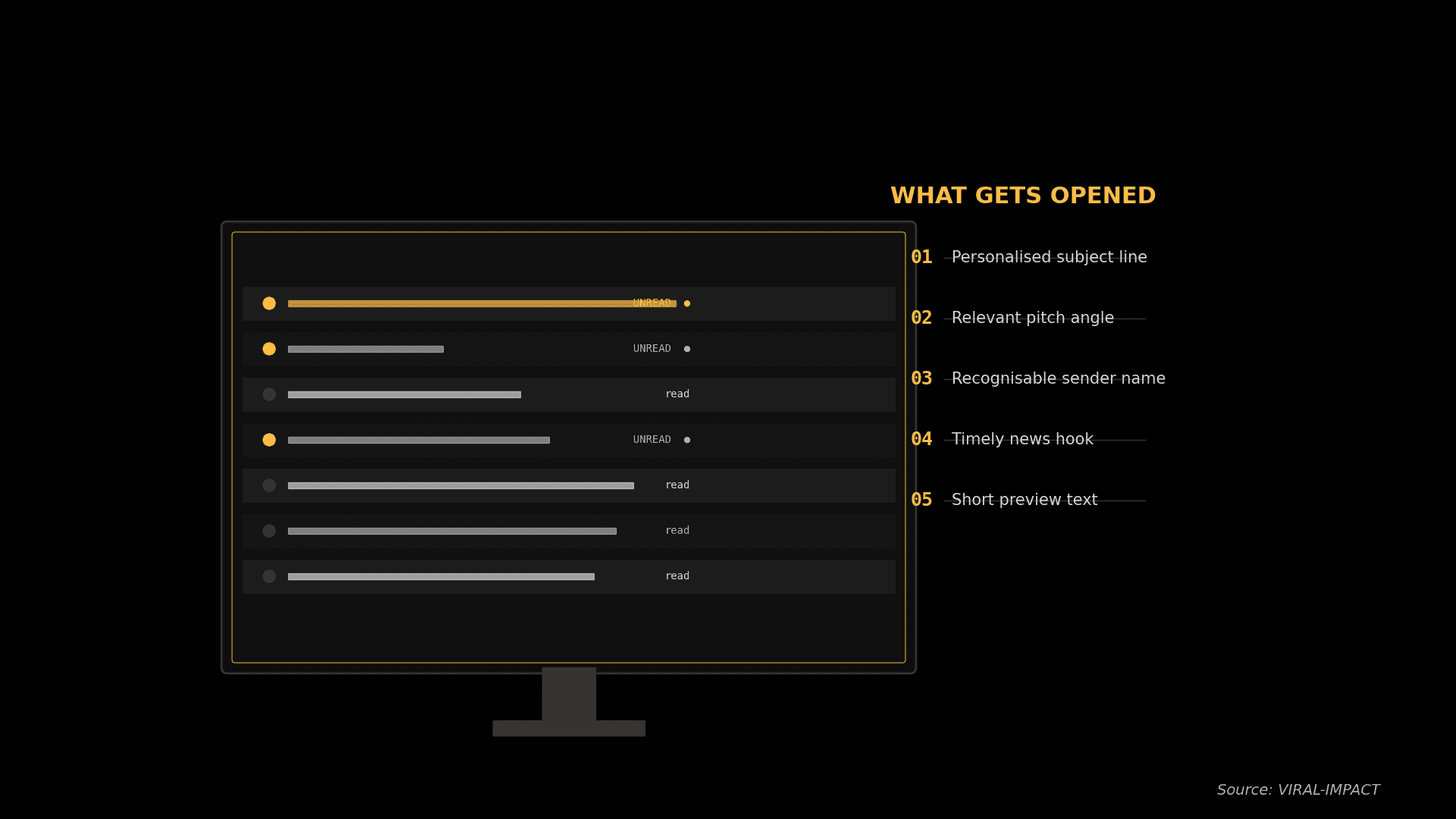
Three elements determine whether a journalist clicks or deletes: the sender name, the subject line, and the preview text. Each plays a distinct role, and weakness in any one of them can sink an otherwise strong pitch.
1. The Sender Name
Journalists are far more likely to open an email from someone they recognise. If your name means nothing to them, your pitch starts at a disadvantage. Building a media relationship before pitching, even a brief reply to their published work, measurably raises open rates. Sending from a personal email address consistently outperforms a generic company address. People respond to people, not brand handles.
2. The Subject Line
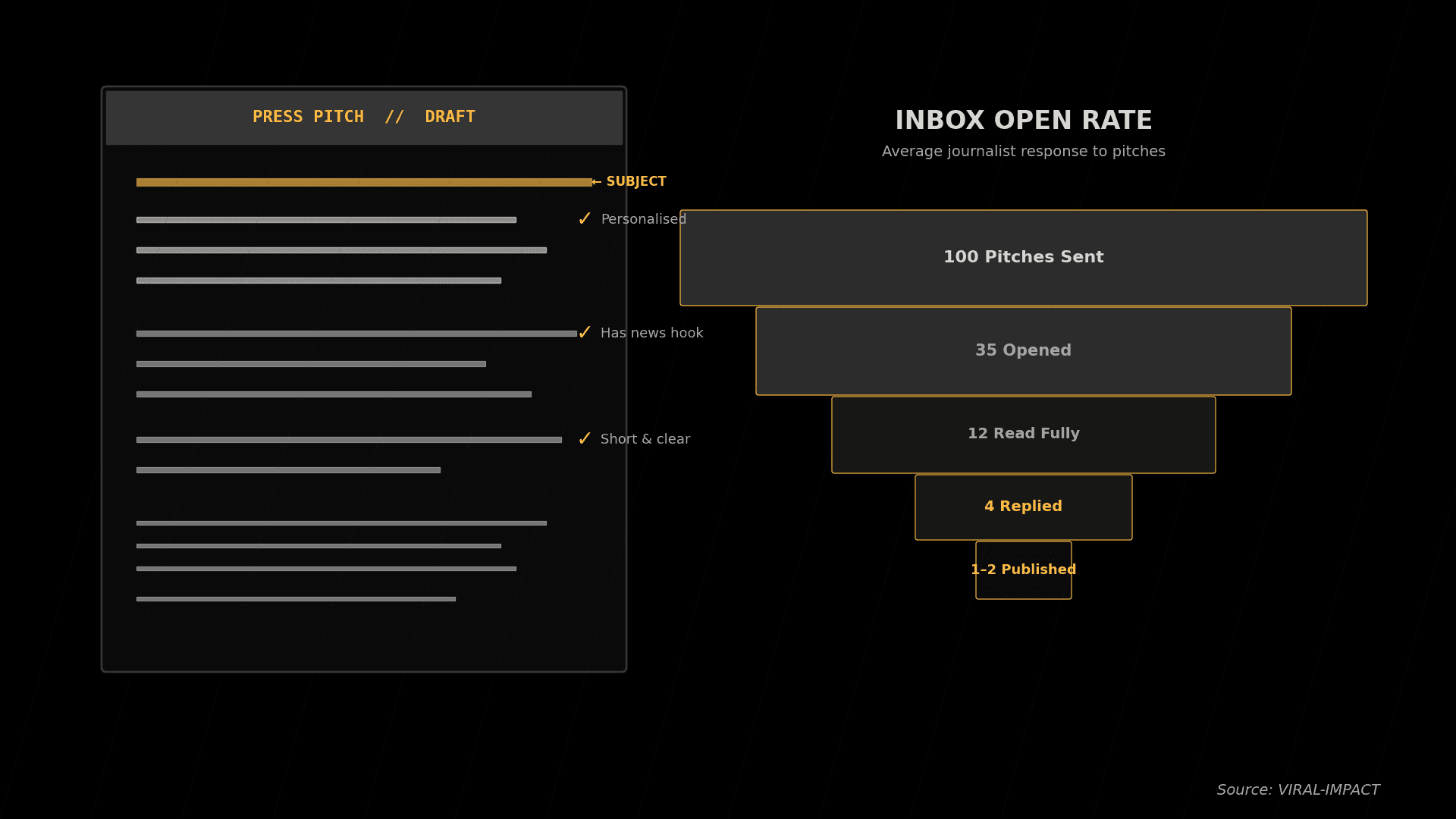
Subject lines that work in journalism outreach share consistent traits. Keep them under 50 characters, make the news angle obvious, and avoid anything that sounds promotional.
Subject lines that consistently get opened:
• Lead with the news angle, not the company name.
• Use a specific number or data point when available.
• Reference a story the journalist has recently published.
• Keep it under seven words where possible.
3. The Preview Text
Preview text is the short line that appears next to the subject in most email clients. Most senders ignore it entirely. The first 80–100 characters of your email body function as preview text, so your opening sentence needs to act as a second subject line. If it reads like standard press release boilerplate, the email dies there regardless of how strong the rest of the pitch is.
Table 1: Email Open Rate Benchmarks for PR and Media Outreach (2024–2025)
Outreach Type | Avg Open Rate | Avg Reply Rate | Best Subject Format |
Cold journalist pitch | 14–22% | 2–5% | News angle + data point |
Warm pitch (prior contact) | 35–48% | 12–18% | Personal reference |
Newsjacking pitch | 28–40% | 8–14% | Tie to trending story |
Exclusive story offer | 42–60% | 20–30% | "Exclusive:" prefix |
Follow-up (Day 3–5) | 18–25% | 4–9% | One-line reply to original |
Source: Cision 2024 State of the Media Report; Muck Rack Journalist Survey 2025
What Journalists Actually Want From Your Pitch
Ask any working journalist, and the answer is consistent: send something newsworthy, specific, and easy to act on. Pitch emails that earn coverage do four things well, and none of them requires a big budget.
The four qualities that make journalists respond:
• Relevance to their beat research the journalist before writing a word. Press Release services built around targeted outreach generate 3× more pickups than generic blast campaigns.
• A clear news angle, not "we launched a product" but "our data shows 67% of remote workers lose two hours daily to this problem, and we built the fix."
• Brevity journalists are on deadline. The pitch that lands in 30 seconds beats the one that takes three minutes to understand.
• A single, obvious ask one question per email. Journalists do not have time to decode what you want from them.
If your pitch still does not land despite hitting all four points, the problem is usually timing. Guest Posting combined with a coordinated PR push keeps your story visible longer than a single pitch cycle.
Common Mistakes That Kill Open Rates
Most bad pitches fail for the same avoidable reasons. Recognising these patterns is the fastest way to improve outreach performance without changing your core story.
The most common pitch mistakes to fix immediately:
• Sending to the wrong journalist or wrong outlet for the story.
• Using a generic opener instead of addressing the journalist by name.
• Leading with the company background instead of the news hook.
• Attaching a full press release PDF before building interest.
• Following up the next day instead of waiting 3–5 business days.
• Including multiple asks in a single email.
Fixing the first two personalisation and targeting produces measurable results within a single campaign. Tools that combine Email Outreach with verified journalist contact data reduce bounce rates and improve inbox placement meaningfully.
Table 2: Journalist Pitch Preferences by Content Type (Muck Rack Survey, 2025)
Content Type | Journalists Who Prefer It | Ideal Length | Response Timeline |
Data-led story pitch | 64% | 100–150 words | 1–3 days |
Exclusive research or report | 58% | 150–200 words | 2–5 days |
Expert commentary/quote offer | 49% | 50–80 words | Same day |
Product launch pitch | 21% | 100–120 words | 5–7 days |
Event invitation | 17% | 80–100 words | 3–5 days |
Source: Muck Rack State of Journalism 2025; Propel Media Barometer Q1 2025
Building a Long-Term Media Relationship
The most effective PR strategy is not transactional. Journalists who know your name open your emails on instinct. Getting there takes consistent, low-pressure engagement over time, a slow build whose payoff compounds.
Practical steps to build genuine journalist relationships:
• Follow their bylines and reference their recent work in every pitch.
• Offer useful data or expert quotes even when you have nothing to pitch.
• Respond quickly when they reach out for comment.
• Share their published stories through your own channels.
This pairs naturally with a broader Organic Growth strategy. When your brand consistently appears in relevant media, credibility with both journalists and search engines grows in parallel. Domain authority built through legitimate press coverage is one of the strongest signals Google still rewards.
For startups, getting featured in even one credible outlet shifts your SEO trajectory in ways that on-page work alone cannot replicate. PR and SEO strategies work best when they run in parallel. This guide on SEO and PR explains the compounding mechanics in full.
Data, Timing, and the Modern Pitch
According to Muck Rack's 2025 report, 73% of journalists say personalisation is the single biggest factor in whether they open a pitch. Cision's 2024 research found journalists receive an average of 14 pitches per hour during peak news cycles. Timing and relevance must work together.
The Propel Media Barometer consistently shows that pitches sent on Tuesday through Thursday mornings outperform weekend sends by more than 40%. Sending at the right time is a free performance improvement that costs nothing except a small adjustment to your scheduling workflow.
FAQs
Q1: How long should a PR pitch email be?
Keep your pitch to 100–150 words. State the news angle in the first sentence, provide brief context, and close with a single clear ask. Anything longer tends to get skimmed and deleted.
Q2:What is the best time to send a press pitch?
Tuesday through Thursday mornings between 7 am and 9 am in the journalist's time zone consistently outperform other windows. Avoid Monday mornings and Friday afternoons.
Q3:Should I attach a press release to a pitch email?
No, not in the first email. Lead with the pitch. Offer to send the full release if they respond. Attachments from unknown senders increase delete rates and trigger spam filters.
Q4:How many times should I follow up with a journalist?
One follow-up, sent 3–5 business days after the original pitch, is the standard. A second after another week is acceptable for time-sensitive news. Beyond that, you risk damaging the relationship.
Q5:Does personalisation really improve open rates that much?
Yes. Pitches referencing a journalist's recent work see open rates 2–3 times higher than generic blasts, per Muck Rack's 2025 data. One sentence of genuine personalisation changes how the entire email reads.
Every pitch that lands in a journalist's inbox competes against hundreds sent in the same hour. The brands and agencies that consistently win coverage have done the work everyone else skips: they know the journalist, understand the beat, and lead with the news rather than the product announcement.
Getting media coverage is not a numbers game in 2025. Sending 500 poor pitches produces worse results than 20 sharp, well-researched ones. Precision beats volume every time. Fix the targeting and personalisation first, and the open rate follows.
When PR strategy and SEO strategy align, press coverage builds backlinks, backlinks improve rankings, rankings generate brand visibility, and organic growth becomes genuinely compounding. That integration requires treating each channel as part of the same system, not isolated tactics running in parallel by coincidence.
Ready to build a PR strategy that actually gets opened? Visit Viral Impact for press release writing, media outreach, and a full organic growth strategy, all in one place.
Read more

Learn which marketing skills remain irreplaceable as AI transforms search, content, and strategy for the next decade.

Learn how to reposition your startup brand after a pivot and maintain marketing momentum without losing your audience.

Learn the key differences between AEO and SEO and discover which strategy your startup should prioritize in 2026.