Learn the exact steps to reduce bounce rates on landing pages and turn more visitors into actual leads.
To reduce bounce rate on landing pages, make sure your page loads fast, your headline matches what the visitor expected, and there is one clear next step to take. Most people leave because something confused them or slowed them down; fix that, and they stay.
Why Do Visitors Leave a Landing Page So Fast?
Before fixing the number, you need to understand why people leave. It almost always comes down to one of these:
• Message mismatch: the ad promised one thing, but the page says something else.
• Slow load time: if the page takes over 3 seconds, many users bail before it loads.
• No clear action: visitors land and don't know what to do.
• Poor mobile experience: content overlaps, text is tiny, CTA is buried.
• Lack of trust: no social proof, no brand signals, no reason to stay.
The chart above shows the average bounce rate drops after applying each optimisation tactic.
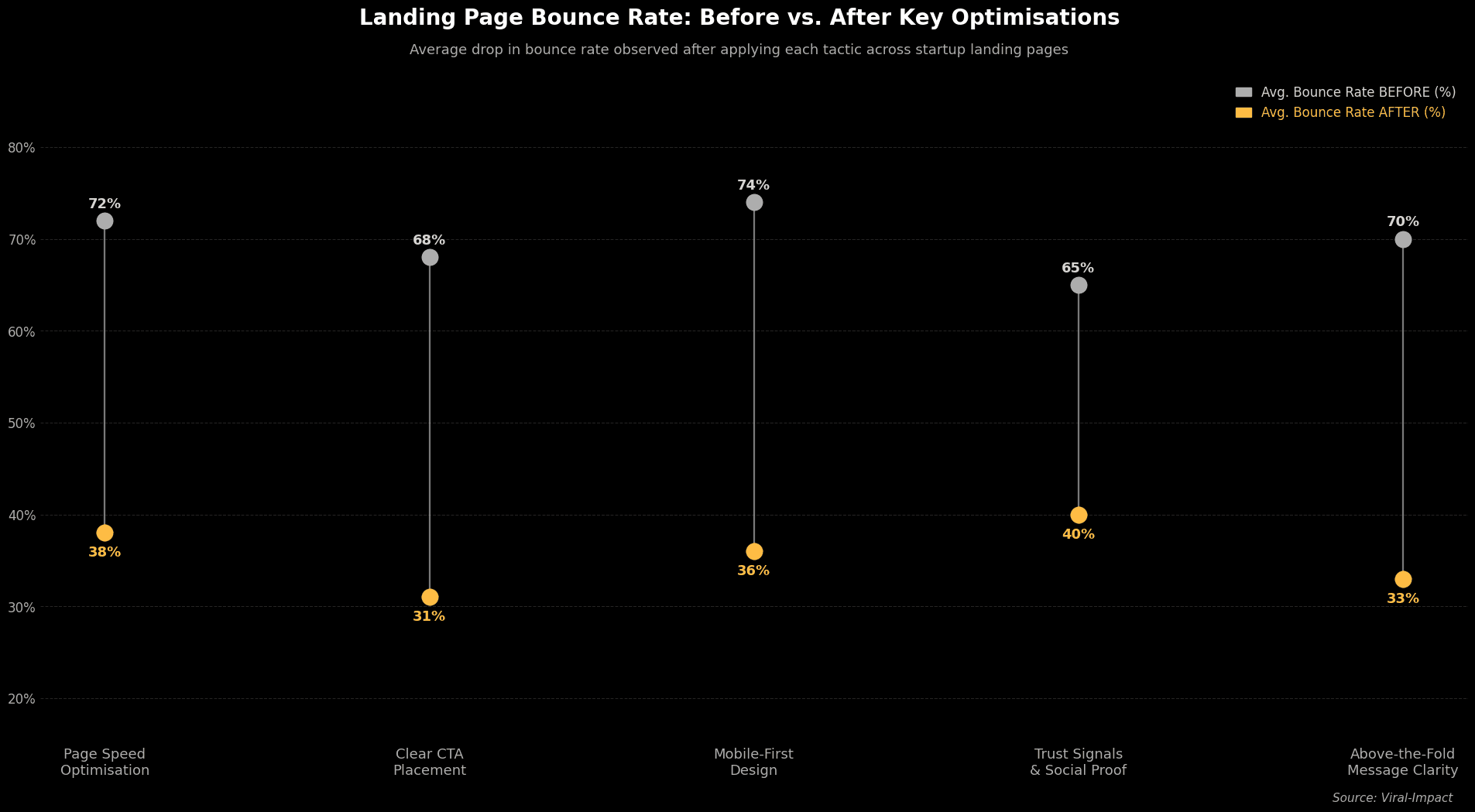
Top Tactics to Lower Bounce Rate on Landing Pages
1. Fix the Headline First
• Match your headline to the exact language in your ads or search results.
• Visitors make a stay-or-go decision in under 5 seconds.
• One specific promise beats a vague tagline every time.
2. Speed Up the Page
• Use a fast host and compress all images before uploading.
• Eliminate unused scripts and third-party trackers.
• Run your page through Google PageSpeed Insights and fix the reds.
3. One CTA. Not Three.
• Every extra link is a leak in your funnel.
• Remove top navigation if your goal is a single conversion.
• Place the CTA above the fold and repeat it below the main copy.
If you need help writing a CTA that converts, Landing Page Copywriting is one of the quickest wins you can make.
4. Design for Mobile First
• Over 60% of landing page traffic comes from mobile devices.
• Stack content vertically and make tap targets easy to hit.
• Use visual hierarchy to guide the eye from headline to proof to CTA.
5. Add Social Proof Above the Fold
• One real testimonial beats a paragraph of features.
• Star ratings, client logos, and user counts build instant trust.
• Place proof right next to your CTA, where doubt is highest.
Quick-Reference: Bounce Rate Fixes at a Glance
Tactic | What to Fix | Expected Impact |
Page Load Speed | Compress images, switch to fast hosting | Bounce drops 10–20% |
Headline Clarity | Match ad copy to landing page headline | Immediate trust boost |
Single CTA Focus | Remove secondary nav and competing links | Conversion focus improves |
Mobile Layout | Stack content, bigger tap targets | Reduces mobile exits 15%+ |
Social Proof | Add real testimonials above the fold | Reduces hesitation fast |
Exit-Intent Popup | Offer a lead magnet before they leave | Recovers 5–10% of exits |
Does Your Website Design Push Visitors Away?
A cluttered page drives people off faster than a slow one. If your current site was not built with conversion in mind, Website Design & Development can rebuild it around what visitors actually need.
• Keep above-the-fold content tight; your offer should be clear without scrolling.
• Strip out navigation menus on standalone landing pages.
• Answer the visitor's main question early, not at the bottom.
For a practical walkthrough on page structure, read How to Design a High-Converting Landing Page.
The Bottom Line
High bounce rate is rarely a mystery. Speed, clarity, and trust, those three things cover most exits. Start with your headline, run a page speed test, and strip out anything pulling attention from the one action you want visitors to take.
If you want a team that handles copy, design, and conversion structure together, visit Viral-Impact.com and see what we build for startups every week.