5 Steps to Build Complete Marketing Plan for Startup
A solid marketing plan is non-negotiable for a startup aiming to thrive in a competitive landscape. It's your roadmap to building awareness, gaining customers, and skyrocketing growth. Without one, even the most groundbreaking product or service might go unnoticed. This guide will walk you through the process of crafting a complete marketing plan tailored to the unique needs of startups.
How to Build a Complete Startup Marketing Plan
A startup marketing plan is a structured roadmap that defines your audience, channels, budget, and goals to drive consistent growth. Without one, most startups burn time and budget on tactics that never compound.
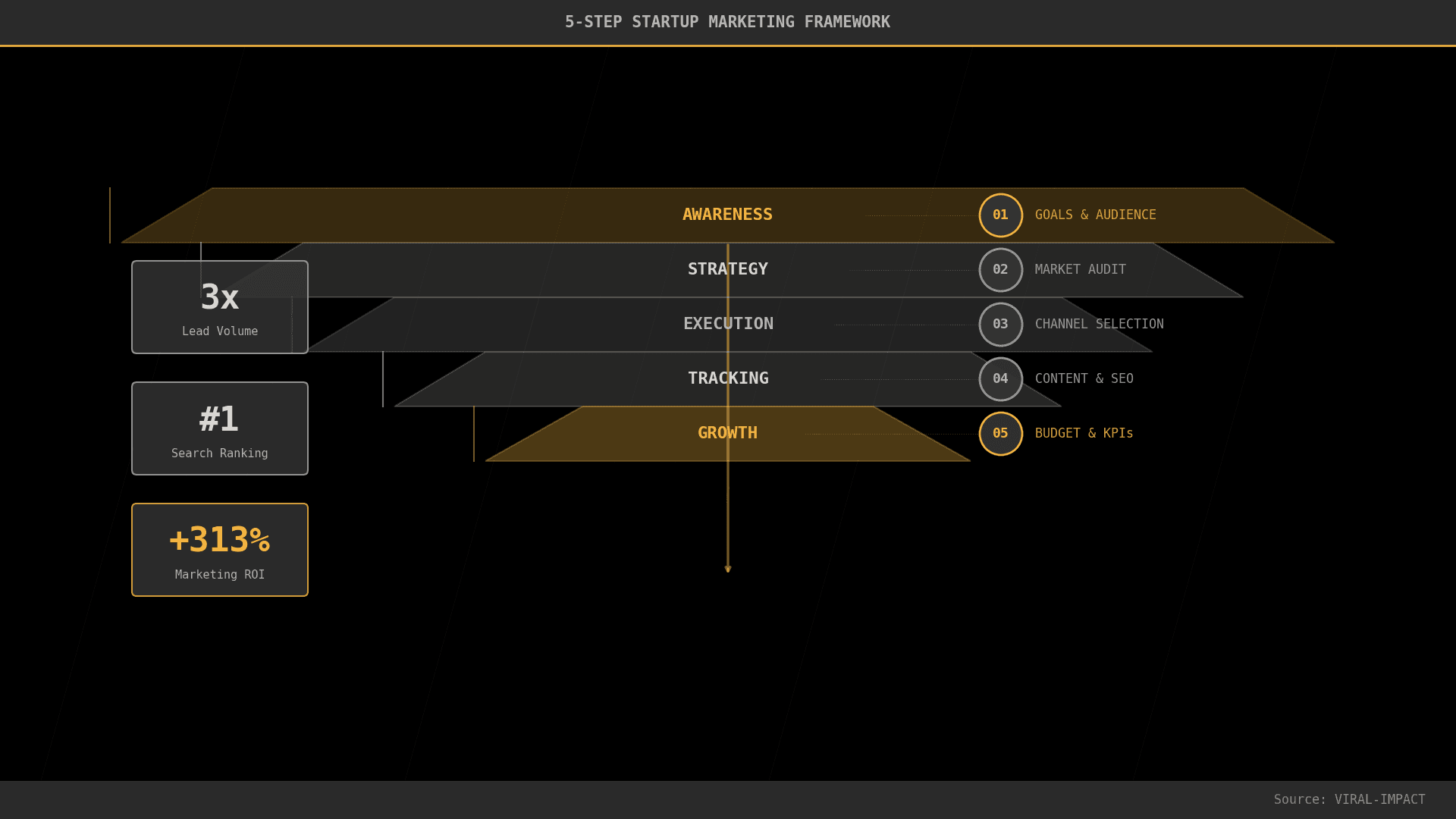
Building a marketing plan is not just about picking channels and hoping traffic follows. Startups that grow fast share one common trait: they execute from a documented strategy. According to HubSpot's 2024 State of Marketing Report, marketers with a written strategy are 313% more likely to report success. Still, fewer than 40% of startups document their marketing approach in year one. This guide walks you through five actionable steps to build a plan that ranks on Google, appears in AI-generated answers, and scales with your business.
Step 1: Define Your Goals and Identify Your Ideal Customer
Every strong marketing plan begins with two non-negotiables: clarity on what you want to achieve and a precise understanding of who you are trying to reach.
Set SMART goals. Vague targets like "get more customers" produce vague results. Define objectives that are Specific, Measurable, Achievable, Relevant, and Time-bound:
• Reach 5,000 monthly organic visitors within 90 days.
• Generate 100 qualified leads per month by Q3.
• Hit a 3% landing page conversion rate by month six.
Next, build a buyer persona. This customer profile covers demographics, job title, pain points, buying triggers, and common objections. Talk to five to ten potential customers before locking it in. Real conversations beat spreadsheet assumptions every time. The sharper your target audience profile, the more precisely every channel decision and content piece performs downstream.
Step 2: Audit Your Market Position and Competitors
Before spending a single dollar or writing a single article, you need to know where you stand. A competitive audit takes a few hours but prevents months of wasted effort.
A useful market audit covers four key areas:
• Keyword rankings: Which keywords does your domain currently rank for, and where are the gaps compared to competitors?
• Competitor content: What are the top three to five competitors publishing, and which topics drive the most traffic for them?
• Backlink profile: How does your domain authority compare to the sites you want to compete with?
• Social presence: Which platforms drive the highest engagement for similar brands in your space?
Use tools like Google Search Console, the free tier of Ahrefs, or SEMrush to gather this data. The goal is to find gaps competitors have left open, not to copy them. Long-tail keywords with clear search intent and low competition are where early-stage startups win their first rankings.
Competitive Audit Framework
Audit Element | Tool to Use | What to Look For |
Keyword Rankings | SEMrush / Ahrefs | Top organic keywords, traffic share, quick-win gaps |
Backlink Profile | Ahrefs / Moz | Domain rating, referring domains, link quality |
Content Gaps | BuzzSumo / Surfer SEO | High-intent topics competitors have not covered well |
Social Engagement | Native Analytics | The platform with the highest interaction rate for your ICP |
Step 3: Choose the Right Marketing Channels
Channel selection is where most startups go wrong. They spread thin across every platform instead of dominating two or three channels that actually match where their buyers spend time.
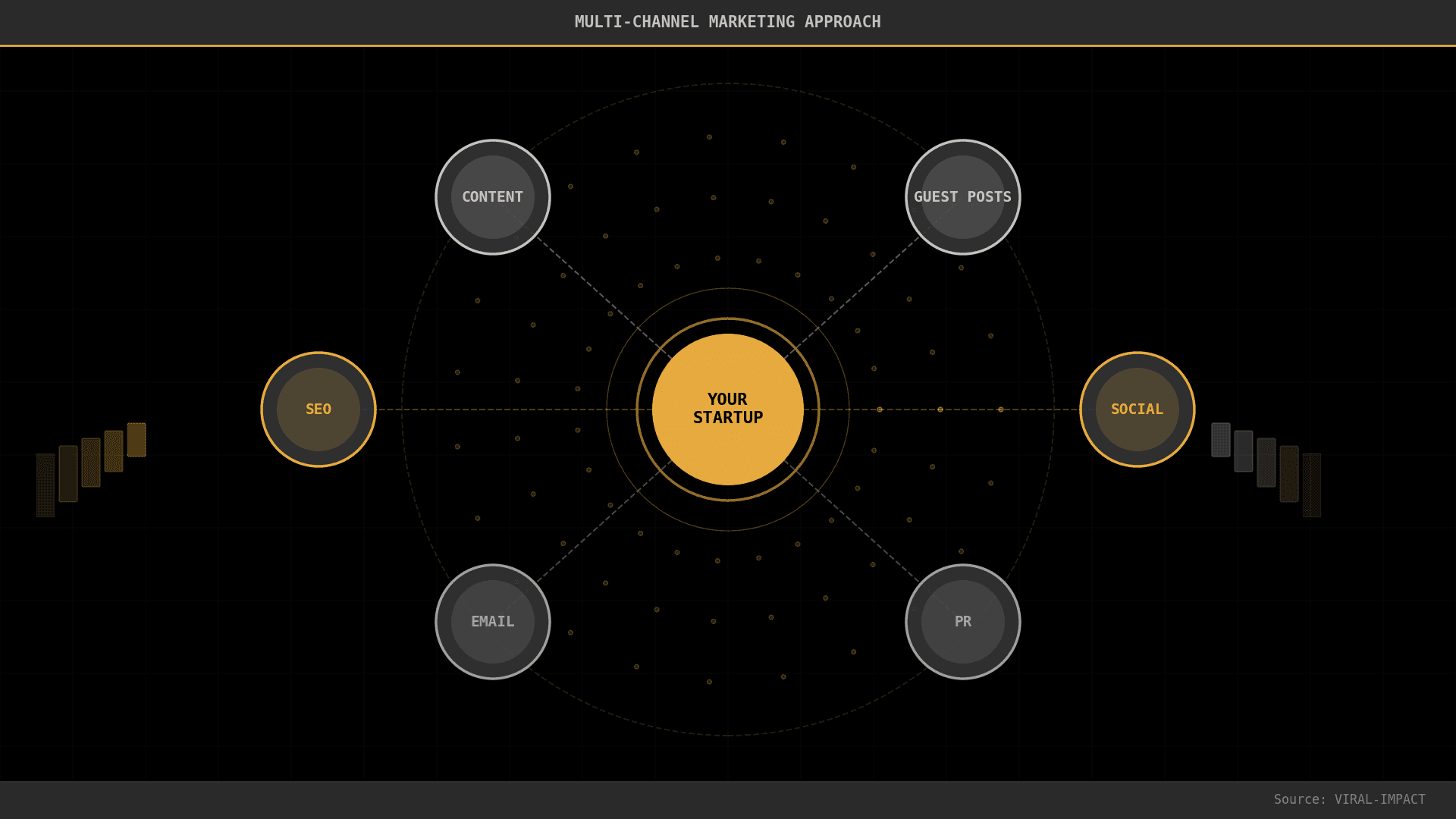
For early-stage B2B startups, these channels deliver the strongest return on effort:
• Organic search: Every ranking article compounds over time. A well-structured SEO strategy is the single highest-ROI investment most startups can make in year one.
• Content marketing: Blog posts, case studies, and comparison pages build authority and answer buyer questions at every stage of the funnel.
• Email campaigns: Direct and measurable. A targeted email outreach sequence consistently outperforms paid ads for B2B startups with a clearly defined ICP.
• Guest posting and PR: Publishing on third-party platforms earns backlinks, builds domain authority, and reaches audiences that already trust the host publication.
• LinkedIn and Reddit: Both platforms outperform Instagram and TikTok for reaching startup founders, operators, and B2B decision-makers.
Pick two channels and go deep before adding more. Traction in two channels proves the model. Spreading across six before that point dilutes every effort.
Step 4: Build Your Content and SEO Strategy
Content is the connective tissue between every marketing channel. It fuels SEO, powers social distribution, supports email sequences, and gives your sales team something worth sharing. Publishing randomly never works; a consistent content system beats one-off articles every time.
A strong startup content strategy rests on three content types:
• Top-of-funnel educational content: Blog posts targeting informational keywords drive discovery and build trust. Use SEO blogs to optimize every post for both Google rankings and AI-generated answers.
• Middle-of-funnel comparison content: "Best X for Y" articles and competitor comparisons that capture buyers actively evaluating solutions.
• Bottom-of-funnel conversion content: Case studies, solution pages, and landing pages designed to convert qualified traffic into leads.
For AEO and GEO optimization, structure every article with a direct definition in the first paragraph, question-and-answer formatting, and a structured FAQ schema. According to Search Engine Journal, structured content with schema markup is 20 to 30% more likely to appear in Google AI Overviews. Investing in organic growth requires consistency over time. For a proven publishing framework, read our guide on content strategy.
Step 5: Set Your Budget, Assign Ownership, and Track KPIs
A marketing plan without a budget and clear accountability is just a document. This final step turns everything above into an operational system.
Early-stage startups typically allocate 10 to 15% of projected revenue to marketing. Pre-seed founders should focus on channels with compounding returns, organic search, content, and email over rented audience platforms like paid social.
Startup Marketing Budget Benchmarks by Stage
Stage | Budget Split | % of Revenue | Primary Goal |
Pre-Seed | 70% organic / 30% brand | 10–12% | Build authority |
Seed | 60% organic / 20% paid / 20% brand | 12–15% | Scale traffic and leads |
Series A | 40% organic / 40% paid / 20% brand | 15–18% | Accelerate growth |
Series B+ | 30% organic / 50% paid / 20% brand | 18–22% | Dominate category |
For KPI tracking, the metrics every startup should monitor monthly include:
• Organic traffic growth rate, month over month.
• Lead volume sourced from organic and content channels.
• Cost per acquisition by individual channel.
• Domain authority growth (track quarterly, not monthly).
• Content-driven pipeline and revenue attribution.
Use Google Analytics 4 and Google Search Console for organic metrics. Keep reporting, a simple monthly dashboard beats a 15-tab spreadsheet. Adjust channel investment every quarter based on what compounds. For AEO blogs specifically, also track featured snippet wins, People Also Ask appearances, and AI citation placements as supplementary content authority signals.
Steps to measure if my startup marketing plan is working
Track three metrics monthly: organic traffic growth, lead volume from marketing channels, and conversion rate by channel. Review domain authority and content performance quarterly to confirm your strategy is compounding, not stalling. With an existing plan, this step-by-step approach will help you stay focused, strategic, and results-driven.
Step 1: Understand Your Target Audience
Your target audience forms the foundation of your marketing plan. If you don’t know who you’re speaking to, your efforts could fall flat. Here’s how to clearly define your target audience:
1.1 Create Buyer Personas
Ask yourself key questions to build a detailed profile of your ideal customer, such as:
What problems are they trying to solve?
What demographics define them (age, location, occupation)?
What are their interests, goals, and pain points?
Tools like Google Analytics, customer surveys, and social media insights can help gather this information. Aim to create 2-3 detailed buyer personas to cover the core segments of your audience.
1.2 Validate Your Assumptions with Research
Avoid relying solely on hunches. Validate your personas with actual market research. You might use tools like keyword analysis to identify customer search behavior or social media listening to uncover trends.
Step 2: Set Clear and Measurable Goals
Marketing without goals is like sailing without a destination. Follow the SMART framework to ensure your goals are:
Specific
Measurable
Achievable
Relevant
Time-bound
For example:
Increase website traffic by 25% in three months.
Generate 50 new leads per month using social media campaigns.
Break your overarching goals into smaller, actionable steps. Clear goals drive team alignment and make it easier to measure success.
Step 3: Choose the Right Marketing Channels
Startups often face limited budgets, which means you need to focus on high-ROI marketing channels. Here’s an overview of options to consider:
3.1 Social Media
Leverage platforms like Instagram, TikTok, or LinkedIn based on where your audience spends their time.
Use visual platforms for consumer-focused brands.
Go professional with LinkedIn for B2B startups.
3.2 Content Marketing
Blogging, videos, and infographics can position your startup as a thought leader while growing organic traffic.
Write actionable content that solves audience pain points.
Share case studies and success stories in your niche.
3.3 Paid Advertising
Pay-per-click (PPC) ads or social media ads are ideal for immediate exposure.
Set daily limits to avoid overspending.
Target audiences using specific demographics and interests.
Step 4: Plan Your Marketing Budget
Your budget determines how much you can invest across channels while staying lean. For startups, every dollar counts. Here’s a quick budgeting method to follow:
4.1 Start Small and Scale
Instead of spreading your budget thin, test campaigns on one or two channels first—track ROI, then double down where you see results.
4.2 Include Fixed vs. Variable Costs
Your budget should account for both fixed costs (tools, subscriptions) and variable costs (ad spend, freelance fees).
4.3 Allocate for Experimentation
Set aside 10-20% of your budget to explore new channels, test growth hacks, or run experimental campaigns.
Step 5: Measure Your Success
A data-driven approach is crucial to improving your marketing plan over time. Establish metrics for continuous tracking and optimization.
5.1 Select Key Performance Indicators (KPIs)
Choose KPIs that align with your goals. Common examples include:
Website traffic and bounce rate
Social media engagement
Lead conversion rates
5.2 Use Analytics Tools
Free tools like Google Analytics or advanced platforms like HubSpot or SEMrush give you deep insights into campaign performance.
5.3 Optimize Regularly
Review performance monthly or weekly, depending on your campaign type, and adjust tactics where needed, whether it’s tweaking ad copy, updating website content, or focusing on underperforming channels.
FAQs
Q1:What should a startup marketing plan include?
A startup marketing plan should cover your target audience, goals, channel selection, content strategy, budget, and KPIs. A focused two-page plan consistently outperforms a 40-slide deck that never gets executed.
Q2:How long does it take to build a startup marketing plan?
A working plan can be drafted in one to two days with ICP and goal clarity. Budget two to four weeks to validate channel assumptions and build a content calendar before full execution begins.
Q3:How much should a startup spend on marketing?
Early-stage startups typically allocate 10 to 15% of projected annual revenue to marketing. For pre-revenue founders, prioritize low-cost, high-ROI channels. SEO, guest posting, and email outreach consistently outperform paid ads in the early stages.
Final Thoughts
Building a marketing plan that delivers real results takes honest self-assessment, disciplined channel selection, and consistent execution. The five steps above are the same framework that moves startups from zero visibility to predictable organic growth.
The most common mistake is treating a marketing plan as a one-time exercise. It should be a living document, reviewed quarterly and updated as your market and product evolve. A documented plan, however rough, will consistently outperform a polished strategy that exists only in someone's head. According to the Content Marketing Institute, brands with a documented content strategy are six times more likely to report strong ROI. Write it down, execute against it, and refine it with real data.
At Viral Impact, we help startups build and execute marketing strategies that drive organic traffic, earn AI citations, and generate qualified leads. From SEO architecture to content production and targeted outreach, our team builds the growth systems that compound over time. Whether you are starting from scratch or looking to accelerate what you have already built, we are ready to help. Start growing with Viral Impact
Read more

Learn which marketing skills remain irreplaceable as AI transforms search, content, and strategy for the next decade.

Learn how to reposition your startup brand after a pivot and maintain marketing momentum without losing your audience.

Learn the key differences between AEO and SEO and discover which strategy your startup should prioritize in 2026.