How to Build a Content Moat Your Competitors Cannot Cross?

A content moat is a strategically accumulated library of original, well-structured content so authoritative that competitors cannot replicate it without years of effort. Building one requires deliberate topic ownership, consistent publishing, proprietary insights, and simultaneous optimization for Google rankings, Featured Snippets, and AI-generated answers.
Most startups treat content as a campaign, something produced in bursts and measured by short-term traffic spikes. That mindset is why their results plateau. The brands that dominate organic search and appear in AI-generated answers are not publishing more; they are publishing smarter. A content moat compounds over time, turning every article, study, and guide into a permanent competitive asset that rivals cannot easily dismantle.
What Is a Content Moat and Why It Matters
The term borrows from Warren Buffett's concept of economic moats, competitive advantages so durable that rivals struggle to cross them. Applied to digital marketing, it describes a content ecosystem so comprehensive, authoritative, and semantically rich that it becomes extremely costly for a competitor to replicate.
A well-built content moat delivers three compounding advantages. First, it strengthens domain authority over time as more topically relevant pages earn backlinks. Second, it improves visibility in AI-generated answers on platforms like ChatGPT, Perplexity, and Google AI Overviews, because AI systems prefer citing structured, authoritative sources. Third, it reduces customer acquisition cost by generating predictable organic traffic that does not disappear when a paid campaign ends. For early-stage companies with limited ad budgets, this makes content the one channel that genuinely levels the playing field.
The 5 Core Pillars of a Durable Content Moat
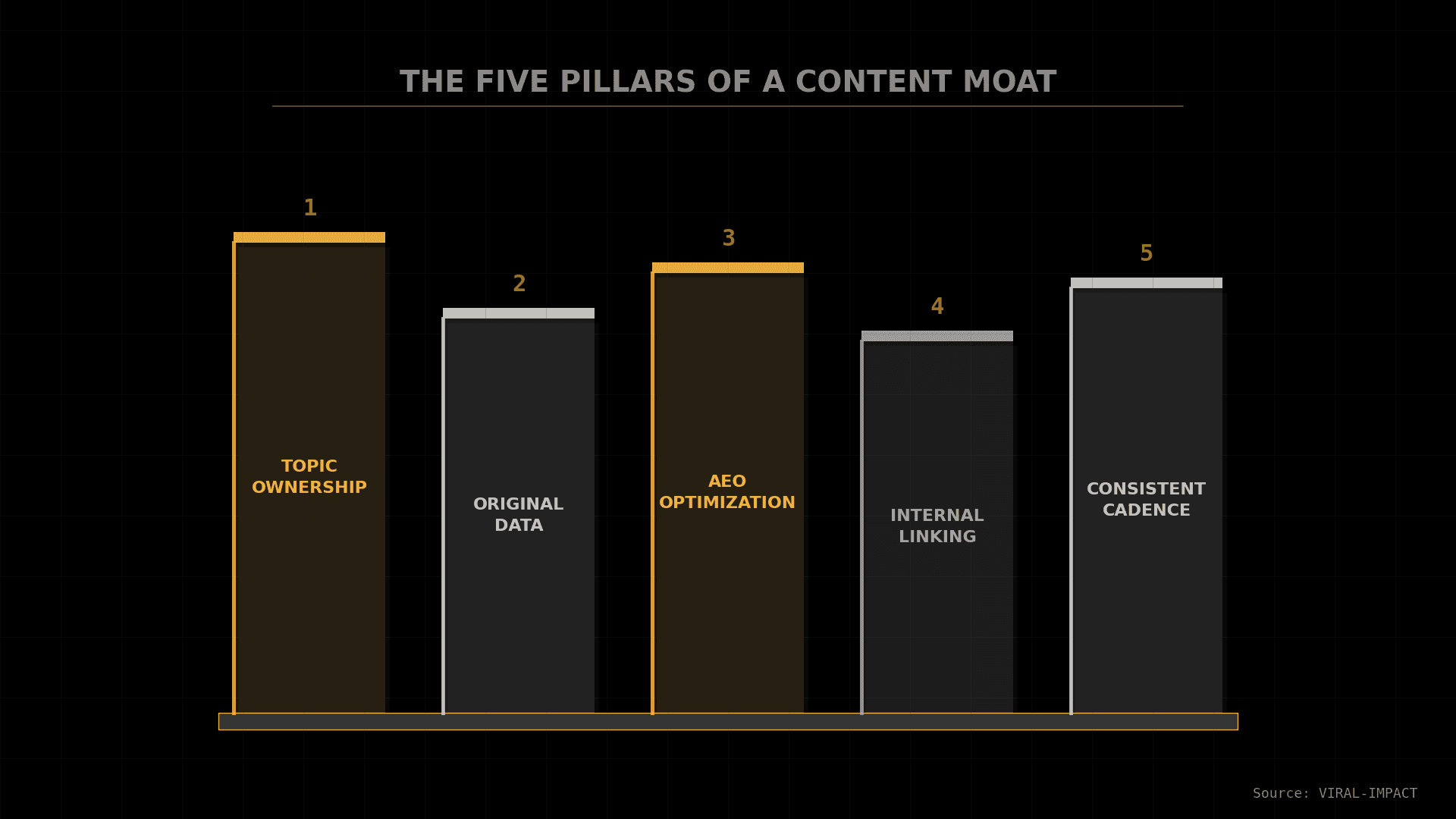
A durable content moat demands strategic depth across five interconnected pillars.
1. Claim Topic Ownership Through Depth
Owning a topic means producing the most thorough, accurate, and useful resource on that subject — not just one article, but an entire cluster. Search engines and AI systems reward topical authority: a site with 20 interconnected articles on cold email outreach will outrank a site with one. Start by mapping every subtopic your audience searches for, then build a structured cluster around it. Your keyword research process should dictate the structure of each cluster, not guesswork.
2. Use Proprietary Data and Original Research
Anyone can republish what is already on the internet. What competitors cannot copy is data you generate yourself, such as customer surveys, platform analyses, or internal benchmarks. Original data earns backlinks organically because journalists and bloggers cite primary sources. A single data-backed article can acquire dozens of referring domains over time and serve as a permanent moat anchor.
3. Optimize for AEO and AI Visibility
A content moat built only for traditional search rankings will shrink as AI-generated answers reduce click-through rates. Every piece you publish should also be structured for answer extraction: clear H2 questions, concise 40 to 60-word answers directly below each heading, FAQ blocks, and structured schema markup. This dual optimization AEO writing alongside traditional SEO ensures your content appears both on Google's first page and inside AI-generated summaries.
4. Build a Strategic Internal Linking Architecture
Internal links distribute authority throughout your content ecosystem and help search engines map your topical depth. Every new article should link to at least two related pieces and one service page. Over time, this creates a network of pages that reinforce each other's rankings. SEO writing that ignores internal linking leaves significant ranking potential on the table.
5. Sustain a Consistent Organic Growth System
Volume alone will not build a moat, but publishing too sporadically prevents compounding. The best content moats are maintained by a consistent system, not a series of one-off campaigns. A structured organic growth strategy ensures every piece of content serves a purpose within your broader funnel: awareness, consideration, or conversion.
Content Moat Strategy Map
The table below maps content types to buyer stages and the primary SEO or AEO tactic each format serves.
Content Type | Buyer Stage | Primary Goal | SEO / AEO Tactic |
Pillar articles (2,000+ words) | Awareness | Topical authority | Rank for broad, high-volume keywords |
Cluster posts (700-1,500 words) | Awareness / Consideration | Long-tail organic traffic | Target question-based queries |
Original research and data studies | All stages | Backlink acquisition | Earn citations from media and blogs |
Case studies and use cases | Consideration / Decision | Trust and credibility building | Target comparison and solution queries |
FAQ and 'What is' pages | All stages | AI snippet capture | Structured Q&A blocks with schema |
How SEO and AEO Compound Your Content Moat
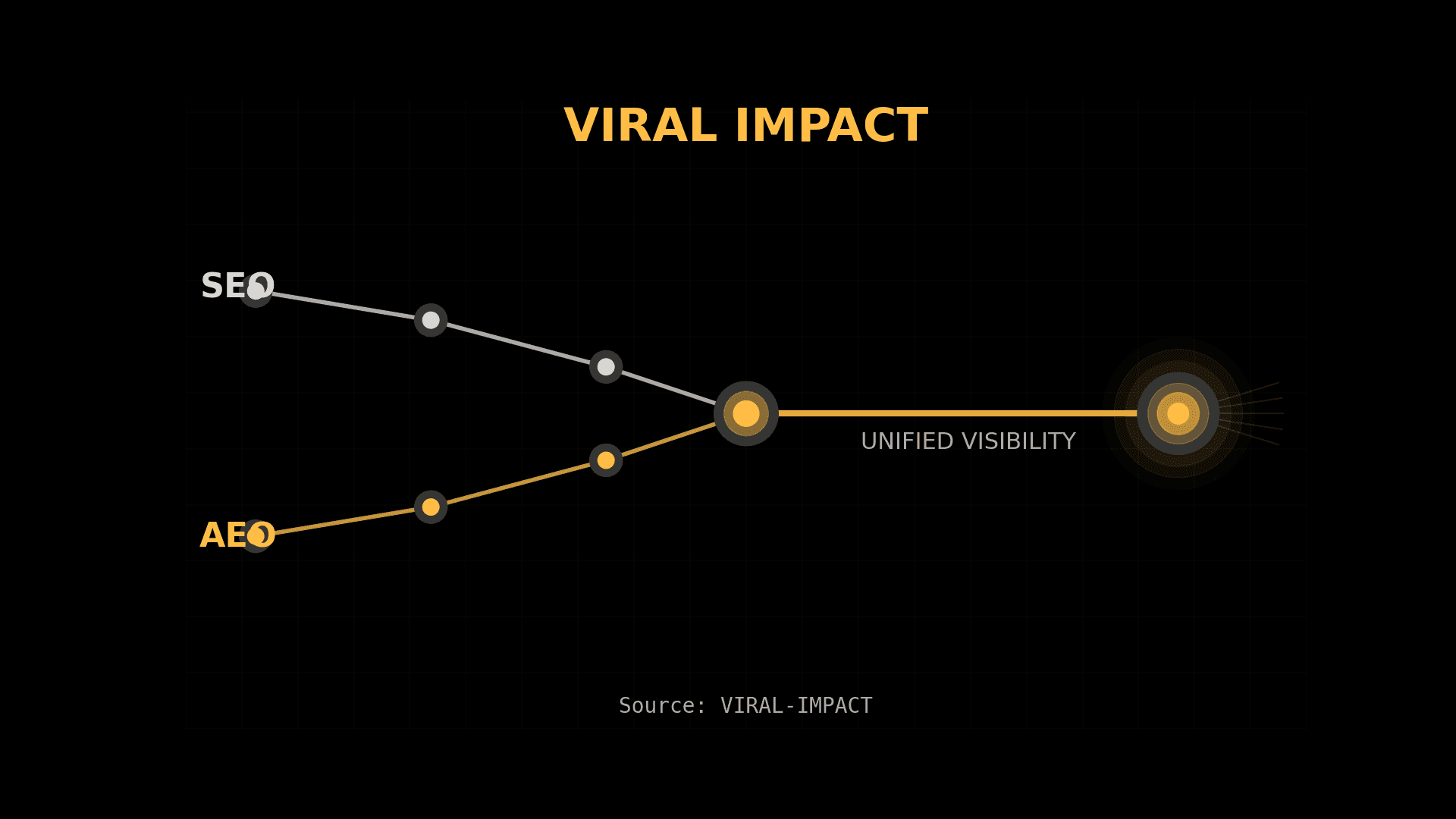
Traditional SEO and AEO Blog Writing are not competing strategies; they reinforce each other. According to research by Princeton's NLP Group (KDD 2024), content that includes cited statistics and direct answer blocks sees up to 40% higher visibility in AI-generated results. That means the same optimization work that improves your Google rankings also increases the chance your content is cited by ChatGPT, Perplexity, or Google's AI Overviews.
The practical implication: every article in your content moat should target a primary keyword, include a concise direct answer near the top, cite at least one credible external source, and use schema markup to signal structure to both search engines and AI systems. When these elements work together, a single well-optimized piece can generate traffic from Google organic, Google AI Overviews, and direct AI tool citations simultaneously.
According to HubSpot's 2024 State of Marketing Report, companies that prioritize blogging are 13 times more likely to see positive ROI. A content moat turns that multiplier into a permanent competitive advantage. For a deeper breakdown of how to execute this, the content strategy guide on our blog walks through the full planning process.
Content Moat Performance Metrics to Track
Use these six metrics to measure whether your content moat is strengthening or stalling each quarter.
Metric | What It Measures | Target Benchmark |
Organic traffic growth | Compounding reach month over month | 10-20% MoM increase |
Topical authority score | Depth and breadth of topic coverage | Rising across target clusters |
AI citation rate | AEO effectiveness across platforms | Monitor monthly via Otterly or Peec AI |
Referring domains acquired | Domain authority building velocity | 5-10 new domains per month |
Featured Snippet captures | SERP real estate and answer visibility | Track via Google Search Console |
Indexed pages with rankings | Size and depth of content moat | Grow quarter over quarter |
Common Mistakes That Erode Your Content Moat
Most startups understand content's value in theory but undermine their own moat through predictable errors. Each mistake below directly reduces topical authority, which slows the entire compounding process.
The most common mistakes to avoid include:
• Publishing high volume with low depth, which signals thin content to Google and AI platforms.
• Ignoring internal linking, which leaves authority trapped in isolated pages.
• Writing for SEO only and missing AI answer optimization, limiting visibility to traditional search.
• Failing to update older content, which degrades freshness signals over time.
• Copying competitors' topics instead of identifying underserved gaps through proper audience research.
• Treating content as a cost rather than an asset, which leads to inconsistent publishing and lost compounding momentum.
According to the Content Marketing Institute's 2024 B2B benchmarks, 73% of the most successful content marketers document their strategy, compared to just 33% of their less successful counterparts. The documentation gap is itself a moat.
FAQs
Q1:What is a content moat in SEO?
A content moat is a collection of high-quality, interconnected content so comprehensive that competitors struggle to replicate it. It builds domain authority, earns organic backlinks, and generates sustained organic traffic without ongoing ad spend.
Q2:How long does it take to build a content moat?
Most startups see meaningful compounding after 6 to 12 months of consistent publishing. Starting with 2 to 4 well-optimized articles per month is more effective than high volume at low quality depth beats breadth early on.
Q3:Can a content moat help with AI search results?
Yes. Content structured with direct answers, FAQ blocks, cited statistics, and schema markup performs well in both traditional search and AI-generated answers. Perplexity and Google AI Overviews favor authoritative, well-structured sources, exactly what a strong moat produces.
Q4:What types of content build the strongest moat?
Pillar articles targeting broad keywords, cluster posts covering subtopics, original research, and FAQ pages optimized for AI extraction. Depth, original data, and consistent internal linking together create the most durable competitive advantage.
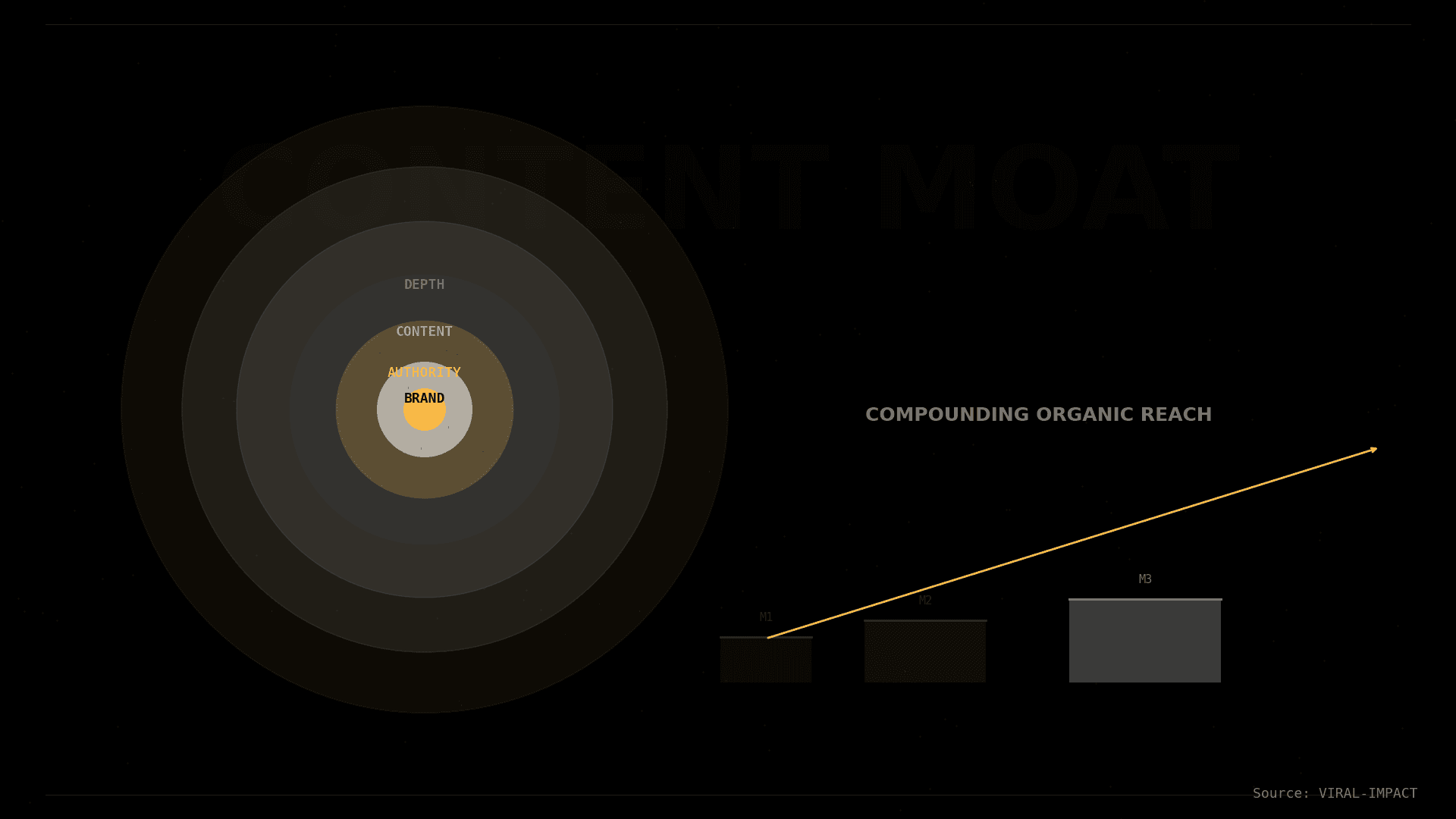
A content moat is not a short-term campaign. It is an infrastructure investment that compounds over time. Every well-optimized article and strategically linked cluster page adds protection that competitors cannot dismantle without equivalent effort. Startups that begin early and optimize for both Google and AI platforms will generate more qualified leads at lower acquisition cost.
Start Building Your Content Moat Today
Viral Impact's team of SEO, AEO, and content specialists designs and executes full content moat strategies for startups and B2B companies. Start building yours today and turn your content into a competitive advantage your rivals cannot cross.
Read more

Learn which marketing skills remain irreplaceable as AI transforms search, content, and strategy for the next decade.

Learn how to reposition your startup brand after a pivot and maintain marketing momentum without losing your audience.
Learn the key differences between AEO and SEO and discover which strategy your startup should prioritize in 2026.