Why Pretty Websites Fail: The Conversion Design Paradox
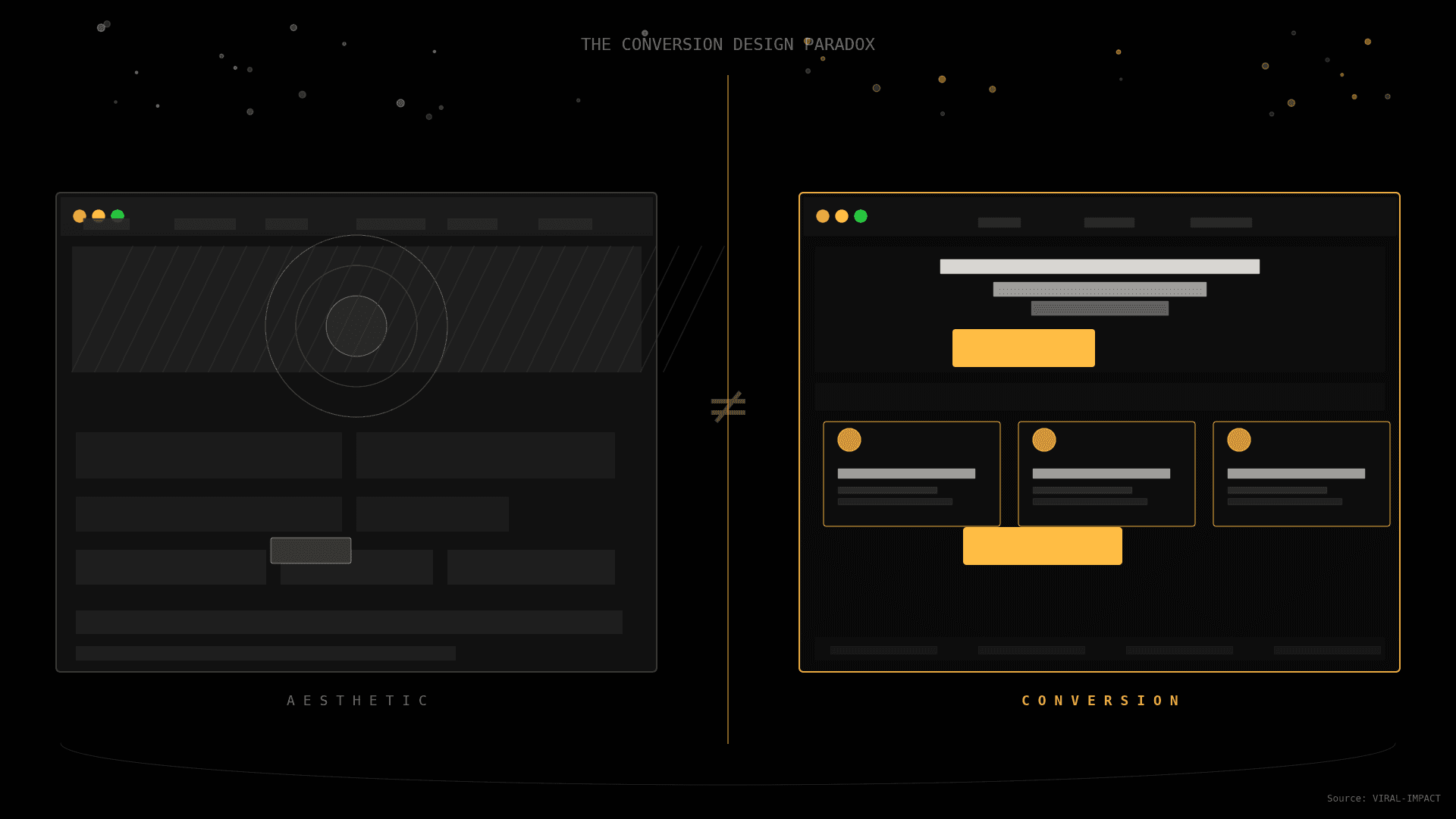
Most startups invest thousands in beautiful website design, yet still watch visitors leave without converting. The real problem is not how your site looks; it is whether it guides people toward a decision.
There is a common assumption in the startup world: a polished, professional website earns trust and converts visitors. So designers get hired, brand colors get picked, animations get added, and then the analytics tell a different story. Visitors scroll, bounce, and disappear. The homepage looks like a design award submission but generates no leads.
This is the conversion design paradox. Visually impressive websites and high-performing websites are not the same thing. Closing the gap means understanding what design is for.
The Aesthetic Trap: Why Good Looks Can Deceive
When a website is visually impressive, it creates an immediate sense of credibility. Researchers at Nielsen Norman Group call this the aesthetic usability effect, where users perceive attractive interfaces as easier to use, even when they are not. That first impression matters. But first impressions are not conversions.
Founders often confuse brand perception with purchase intent. A stunning hero section tells visitors your company looks sophisticated. It does not tell them what you do, who it is for, or what to do next. Those three things are what actually drive conversions.
Pretty websites can also mask poor performance. Users stay longer to browse animations and visual content; the session duration looks healthy, while form submissions stay at zero. That engagement is decorative, not functional.
What Conversion-Focused Design Actually Means
Conversion-focused design is not the opposite of beautiful design. It is designed with a clear purpose: move a specific visitor toward a specific action. The difference appears in the decisions a designer makes before choosing a single color or font.
A conversion-focused designer asks these questions from the start:
• Where does the eye go first on this page?
• Is the value proposition visible above the fold within five seconds?
• How many clicks does it take to reach the call to action?
• Does the layout remove friction at decision points, or add to it?
• Are trust signals placed where doubt typically appears?
When startups optimize only for visual appeal, they produce websites that impress in screenshots and underperform in real-world conditions. This is exactly where professional UX design creates a measurable impact. Good UX is invisible; users find what they need and act, without ever noticing why the layout made that so easy.
Five Design Decisions That Kill Conversions
According to Baymard Institute usability research, poor UX and confusing design are among the top reasons users abandon websites. These five mistakes appear consistently on high-traffic but low-converting sites:
1. Unclear value proposition above the fold. If visitors cannot understand your offer in five seconds, they leave. Creativity loses to clarity every time.
2. Weak or buried calls to action. CTAs styled to blend with the palette or placed only at the bottom reduce click-through rates sharply.
3. Too many visual distractions. Heavy animations and auto-playing videos slow load times and pull attention away from the core message.
4. Social proof is placed after the decision point. Testimonials below the CTA do nothing to reduce hesitation before users commit.
5. No clear content hierarchy. When every element competes for equal visual weight, users scan instead of reading and leave without acting.
Design Decisions and Their Conversion Impact
Design Element | Aesthetic Priority | Conversion Impact |
Above-fold headline | Creative, brand-aligned | High clarity beats creativity |
CTA button style | Subtle, matches palette | Low contrast drives clicks |
Page animations | Engages and impresses | Negative slows load, distracts |
Social proof placement | Bottom of page | Low must appear near the CTA |
Whitespace | Looks premium | Positive reduces cognitive load |
Mobile layout | Responsive scaling | High 63% of B2B traffic is mobile |
Visual Hierarchy: The Principle That Drives Action
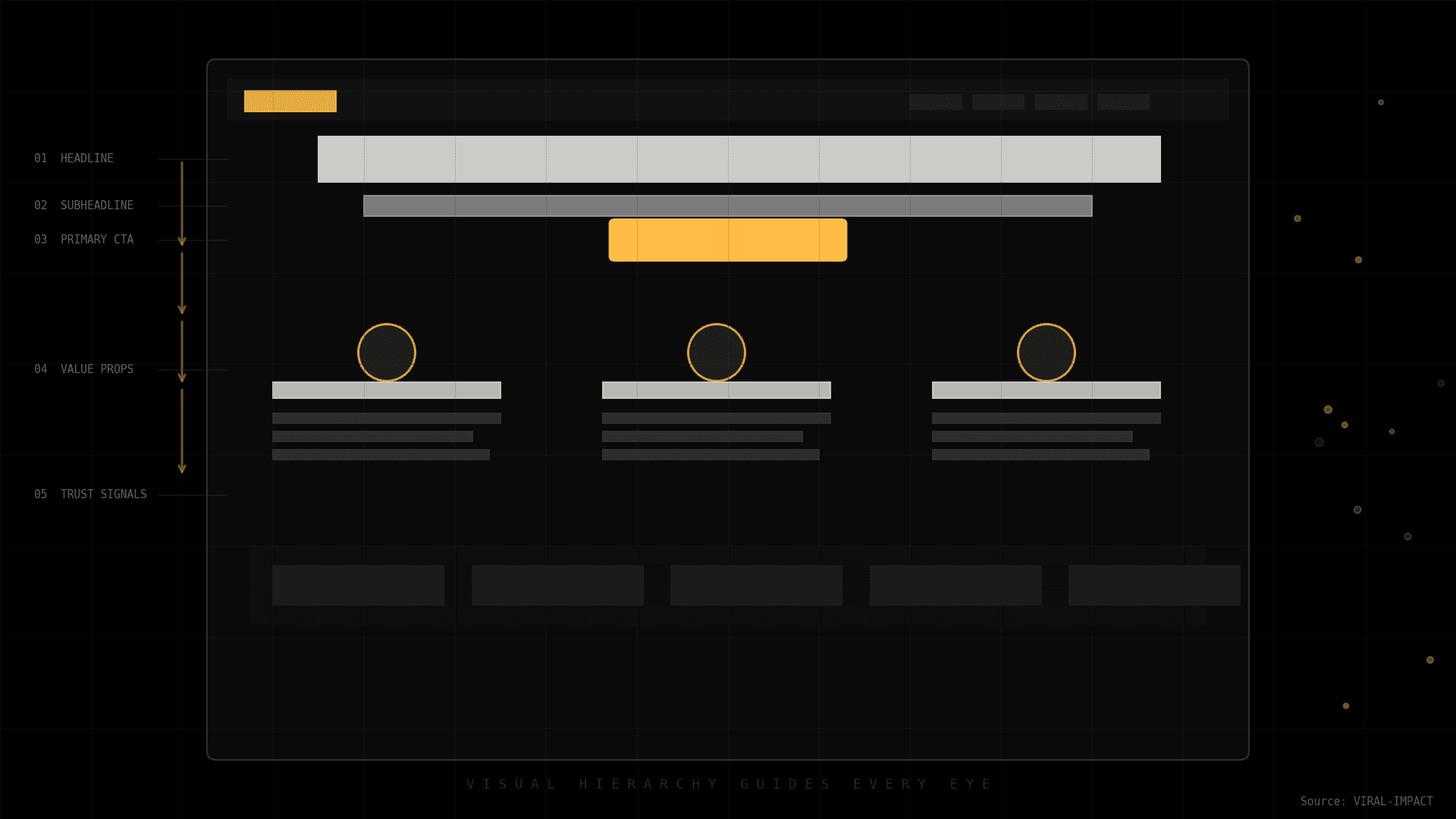
Visual hierarchy is the arrangement of elements in a way that signals importance and guides the eye through a sequence. A well-structured page flows logically: attention lands on the headline, moves to the subheadline, and reaches the call to action. Without it, everything competes, and nothing wins.
Bold text, size contrast, color contrast, and whitespace are the four tools that build hierarchy. Used with intention, they can be both visually strong and functionally clear. The best website design teams treat aesthetics and conversion logic as a single discipline, not two separate phases.
The Page Speed Problem That Silently Kills Conversions
Speed is a design problem as much as a technical one. Every large image, custom font, and heavy animation adds weight. Google Core Web Vitals data shows that a one-second delay in mobile load time reduces conversions by up to 20%.
Designers focused purely on aesthetics often deliver files that are technically beautiful and practically unusable, with uncompressed images, full font libraries loaded for three characters, and scripts blocking above-the-fold render. Conversion-focused design addresses performance at every stage, not just at launch. This is why a complete organic growth strategy always includes site performance reviews. Fast sites rank better and convert better.
What High-Converting Websites Actually Look Like
The idea that converting websites must look plain is wrong. Many top-performing B2B and SaaS sites are also visually strong. The difference is that their design choices serve the user journey. Common patterns on high-converting sites include:
• A single outcome-focused headline that names a problem or a result
• One primary CTA, repeated at logical intervals, without visual clutter competing around it
• Testimonials and case study results placed near pricing and commitment sections
• Real product interfaces or real people in images, not stock photography
• Navigation stripped to the minimum for first-time visitors
• Specific, direct page copy that speaks to the reader's exact pain, not the brand's story
Every element earns its place by serving a function. Investing in strong page copy alongside design is what separates sites that generate leads from those that only look impressive.
Aesthetic Design vs Conversion-Focused Design
Characteristic | Aesthetic-First | Conversion-First |
Primary goal | Visual impression | Guided user action |
Headline approach | Brand storytelling | Problem-solution clarity |
CTA placement | End of page | Above fold and repeated |
Image selection | Brand mood | Social proof and context |
Animation use | Engagement and delight | Minimal or none |
Measurement | Subjective approval | A/B testing and heatmaps |
Suggested Charts for This Blog
Chart 1 Lollipop Chart: "Impact of UX Factors on Conversion Rate" six UX factors plotted against relative conversion lift. Black background, #FFBD45 dots, #ADADAD stems, 1920x1080px.
Chart 2 Radar Chart: "Website Quality by Dimension" comparing aesthetics-focused vs conversion-focused sites across visual appeal, load speed, CTA clarity, trust signals, mobile UX, and copy clarity. Black background, #FFBD45 vs #ADADAD, 1920x1080px.
Chart 3 Line Chart: "Conversion Rate vs Page Load Time" declining curve from 1 to 6 seconds based on Google data. Black background, #FFBD45 line, #D8D6D2 labels, 1920x1080px.
Ready to Build a Website That Converts as Well as It Looks?
At Viral Impact, we build websites that are visually compelling and conversion-optimized from day one. Our team combines data-driven UX with strategic messaging to turn visitors into real business leads. Start by reading our full guide on landing pages, or visit viral-impact.com to explore our full-stack growth services. Your next client may already be on your website make sure your design is doing its job.
FAQs
Q1:What is the conversion design paradox?
It is the disconnect between visually impressive websites and high-converting ones. A site can look polished while still failing to move visitors toward any action because aesthetics and persuasion must be designed together deliberately, not treated as separate concerns.
Q2:Can a website be both beautiful and high-converting?
Yes. The best-performing websites are often visually strong. The difference is that every design decision serves the user journey. Clarity comes before creativity, but the two work together when the right process is in place from the start.
Q3:What is the most common design mistake that kills conversions?
Hiding or weakening the call to action. When CTAs blend with the page, sit only at the bottom, or compete with multiple other buttons, click-through rates drop significantly. A single high-contrast primary CTA consistently outperforms multi-option layouts.
Q4:How much does page speed affect conversion rates?
According to Google research, a one-second delay in mobile load time reduces conversions by around 20%. Pages loading under two seconds see significantly better form completion rates than those taking three or more seconds to load.
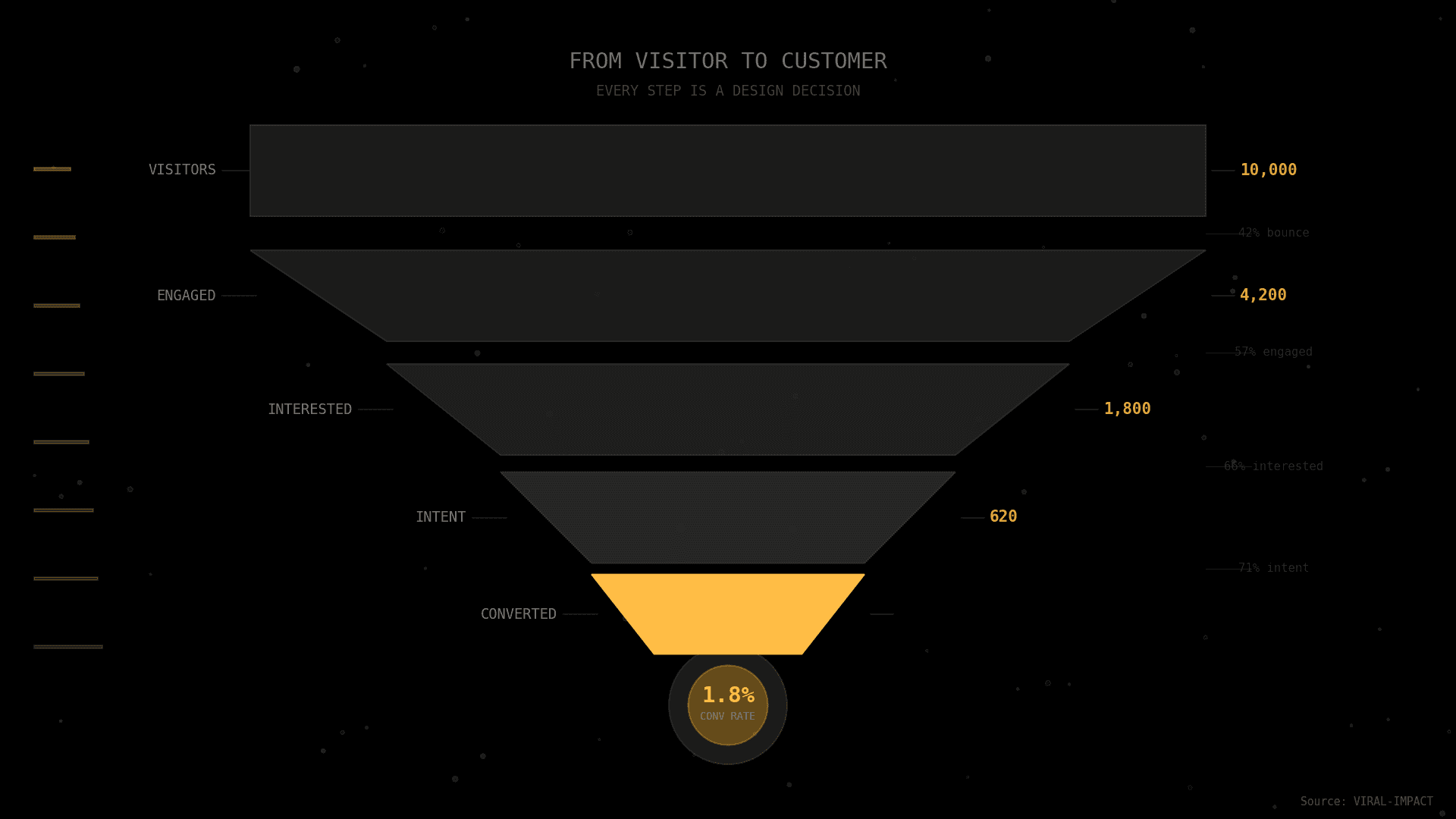
A website that looks great is not a liability; visual quality builds credibility and signals professionalism, especially for early-stage startups competing against established brands. But a website that exists only to impress is a missed opportunity.
The companies that consistently generate leads have internalized one idea: design is not decoration applied on top of content. It is the system that determines whether anyone reads that content and acts on it. When design and conversion logic are built together, every visual choice supports a business outcome. It resolves the moment you stop asking "Does this look good?" and start asking "Does this guide my visitor toward a decision?"
Read more
Learn which marketing skills remain irreplaceable as AI transforms search, content, and strategy for the next decade.

Learn how to reposition your startup brand after a pivot and maintain marketing momentum without losing your audience.
Learn the key differences between AEO and SEO and discover which strategy your startup should prioritize in 2026.